Whoever has not yet tired of following my scholarly work may like to hear about two interesting recent articles on my subject
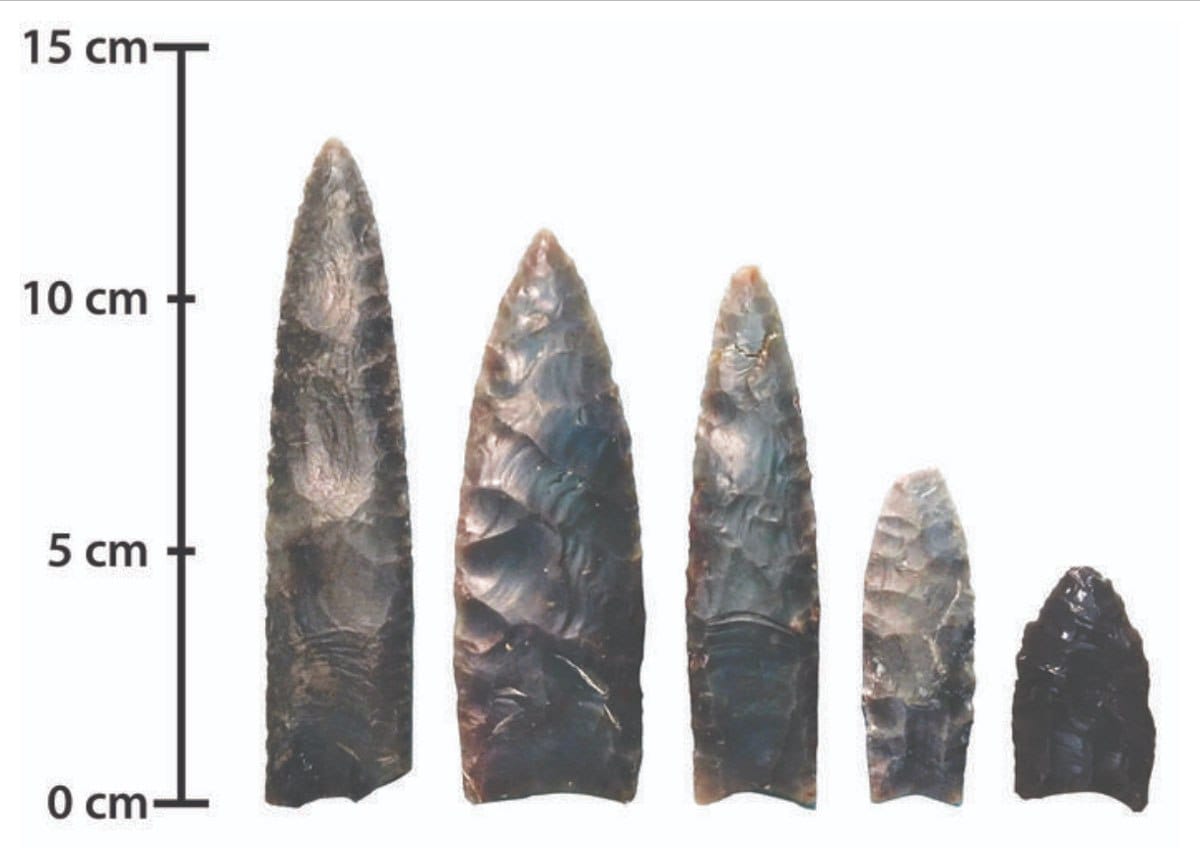
Whoever has not yet tired of following my scholarly work may like to hear about two interesting recent articles on my subject. One, by Ben Potter, maintains that the Palaeoindians were megafauna specialists who followed the mammoths from Alaska to Patagonia. Nothing especially sensational here.
But the second article, by those luminaries Metin Eren, David Meltzer and John Speth, published, incidentally, on the very same day, asserts that there is, strictly speaking, no proof of hunting at any of the fifteen sites where Clovis points lie beside the bones of proboscideans.
The argument is simple: not a single point has been found lodged in a mammoth bone. As for marks on bones, those left by butchery and those left by hunting are practically impossible to tell apart. If one pictures the size of a mammoth carcass, it is clear that, whether killed by people or found by them already dead on the tundra, such a mountain of meat would feed a whole band for a month. But the authors go on to recall one of the key finds for the entire Clovis settlement theory, the "Anzick child". Isotopes in his bones showed a monstrous nitrogen content, meaning that the mother of this eighteen-month-old infant was eating like an apex predator. In this connection Eren observes that a human being cannot digest so much protein, and proposes a hypothetical source: fly larvae on carrion, which contain precisely the right amount of nitrogen.
It turns out that the discoverers of the American continent were possibly not following the mammoths because they hunted them, but specialised in eating maggots from the decaying flesh of Pleistocene megafauna. This does not diminish the significance of the pioneering itself, merely offers a new notion of the diet, which, of course, will look rather worse in museum dioramas