Symbolism of the scene in Joseph's workshop in John Everett Millais's painting of 1850
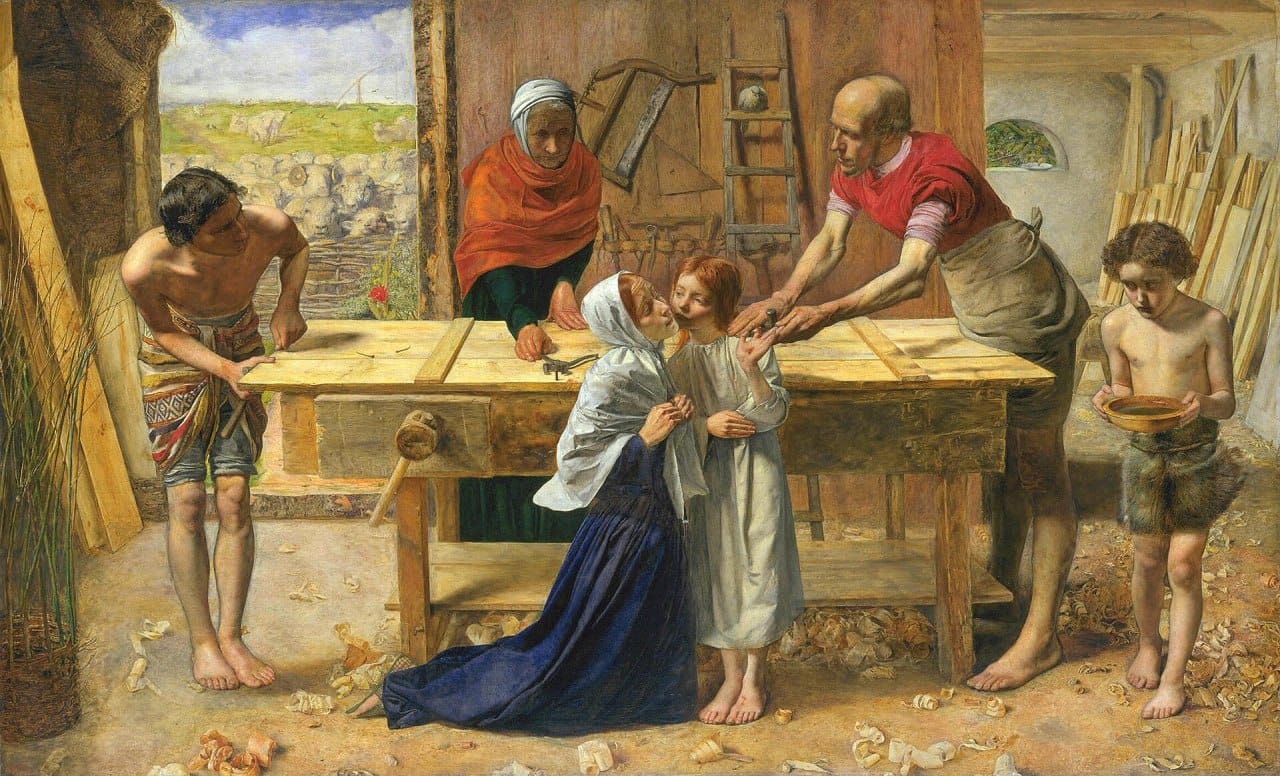
Christ in the Carpenter's Shop.
John Everett Millais, 1850.
The young Jesus Christ has hurt his palm on a nail sticking out of a door and shows the wound, at the place of the future stigmata, to the Virgin Mary.
I am the door: by me if any man enter in, he shall be saved
John the Baptist approaches Christ with a bowl of water, symbolising the baptism to come and ritual ablution. The Virgin in blue comforts her son, hands folded in prayer. Saint Anne brings a pair of pincers to the nail on which Jesus hurt himself; we are shown the tools with which Jesus will be taken down from the cross. Joseph carries on working at the carpenter's table, which resembles a church altar, where the sacrament of communion is performed. Joseph is helped by a nameless youth, most likely one of Christ's future apostles.
The ladder in the background points us to one of the instruments of the Passion of Christ, the ladder from which he will be taken down from the crucifixion. On the other hand, it is also Jacob's Ladder, joining earth and heaven. The triangle beside it is a sign of the Trinity. The dove perched on it is a symbol of the presence of the Lord, of divine protection over this workshop and of the coming meeting with the Lord on the way of the ascent to heaven.
All the participants in the scene stand barefoot, as a sign of their humility.
The wicker basket being woven recalls the crown of thorns that is being prepared for Christ. The large hewn planks are a symbol of the Cross on which Christ will be crucified.
The flock of Christ is still outside the doors and can only peer into the workshop. In the far distance a well can be seen, a source of purity and life-giving water. The red flower symbolises the blood of Christ that will one day be shed.