How the funeral of Pope Francis went today, 26 April 2025
Pope Francis died on the morning of 21 April in the Vatican of a stroke and heart failure. In the evening the rite of certifying death and placing the body in the coffin was performed.
On 22 April official photographs of the pontiff in his coffin were published, taken in the House of Saint Martha, an annexe to Saint Peter's Basilica in the Vatican, which serves as the residence of the Pope and also as the lodging of the cardinals assembling for the conclave.
On 23 April the coffin with the pontiff's body was placed in Saint Peter's Basilica for public farewell, open to the faithful for three days. In that time about 200,000 people visited the Basilica.
On the morning of 26 April, immediately before the start of the funeral ceremony, the ring of Pope Francis, also known as the Fisherman's Ring, was broken with a hammer by Cardinal Kevin Joseph Farrell, who acts as Camerlengo, the official who administers the affairs of the Vatican in the interval between pontificates. The broken signet ring was laid in the coffin so as to preclude any possibility of its further use.
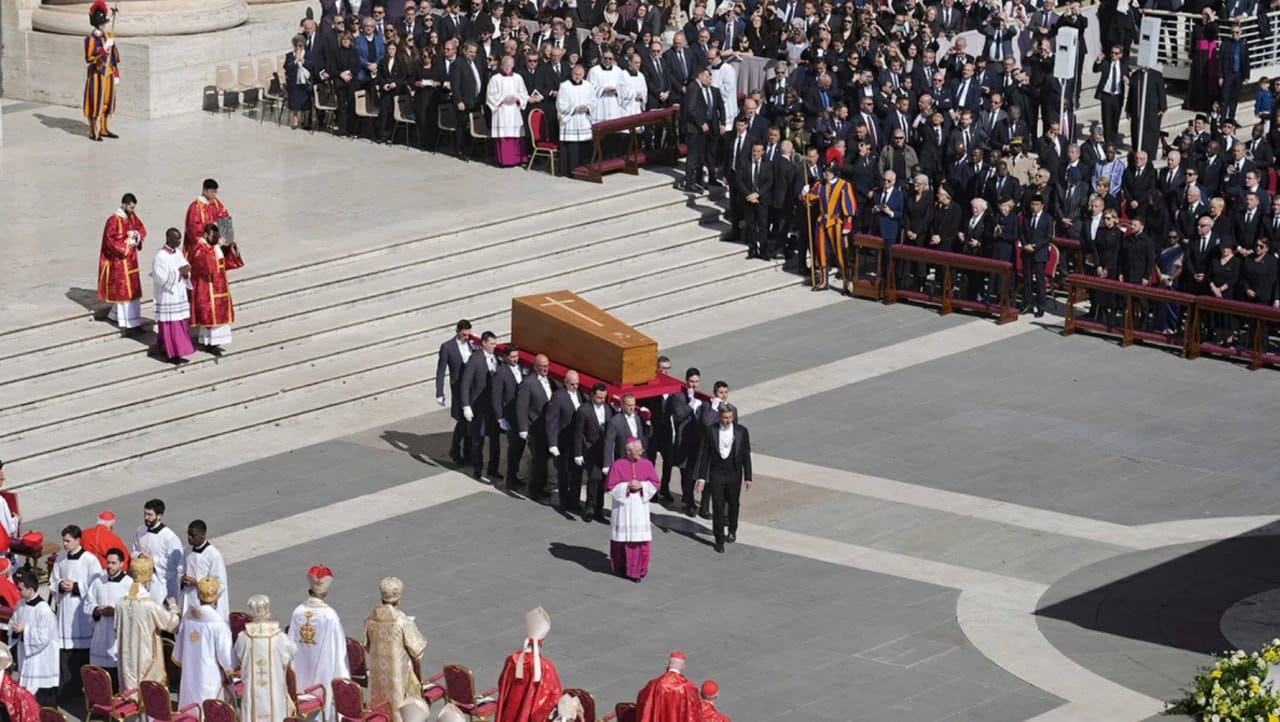
At 10 a.m. on 26 April the funeral ceremony began in Saint Peter's Square in the Vatican. It was attended by over a hundred delegations and dozens of world leaders, as well as hundreds of thousands of the faithful. Built by Gian Lorenzo Bernini in 1656–1667, Saint Peter's Square can ordinarily hold up to 60,000 people.
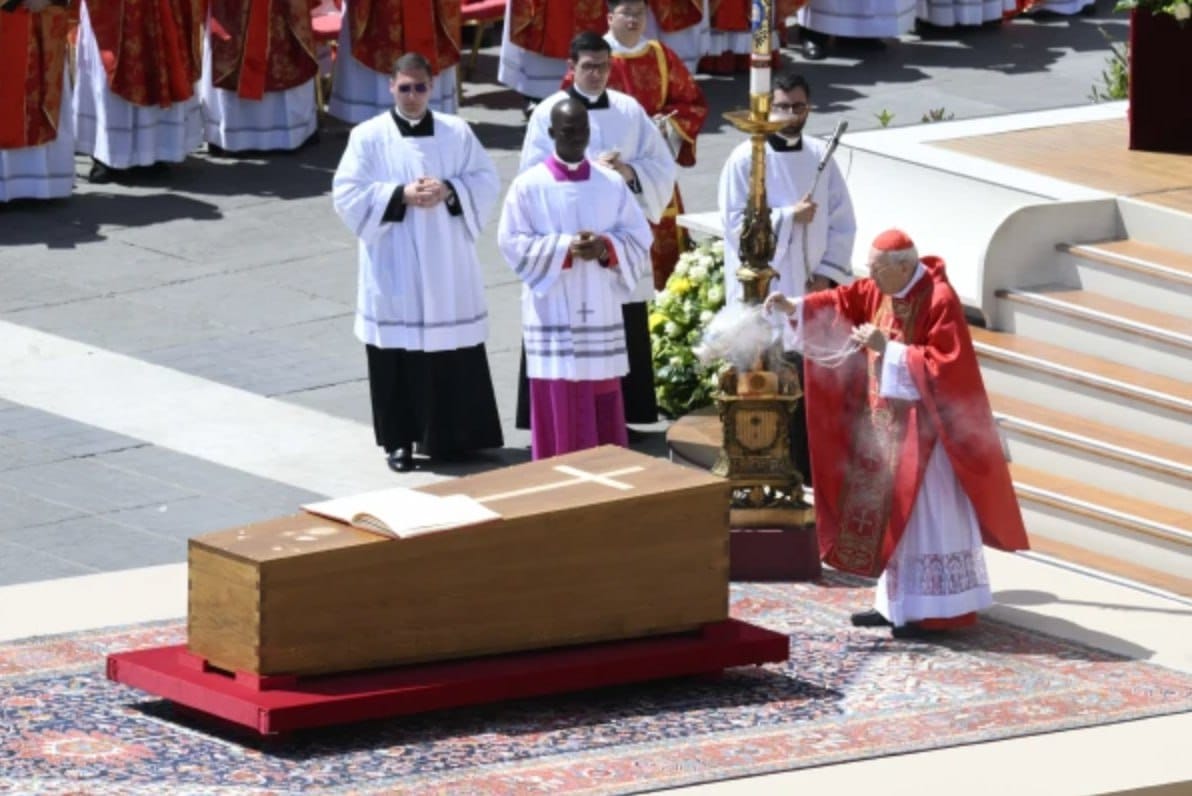
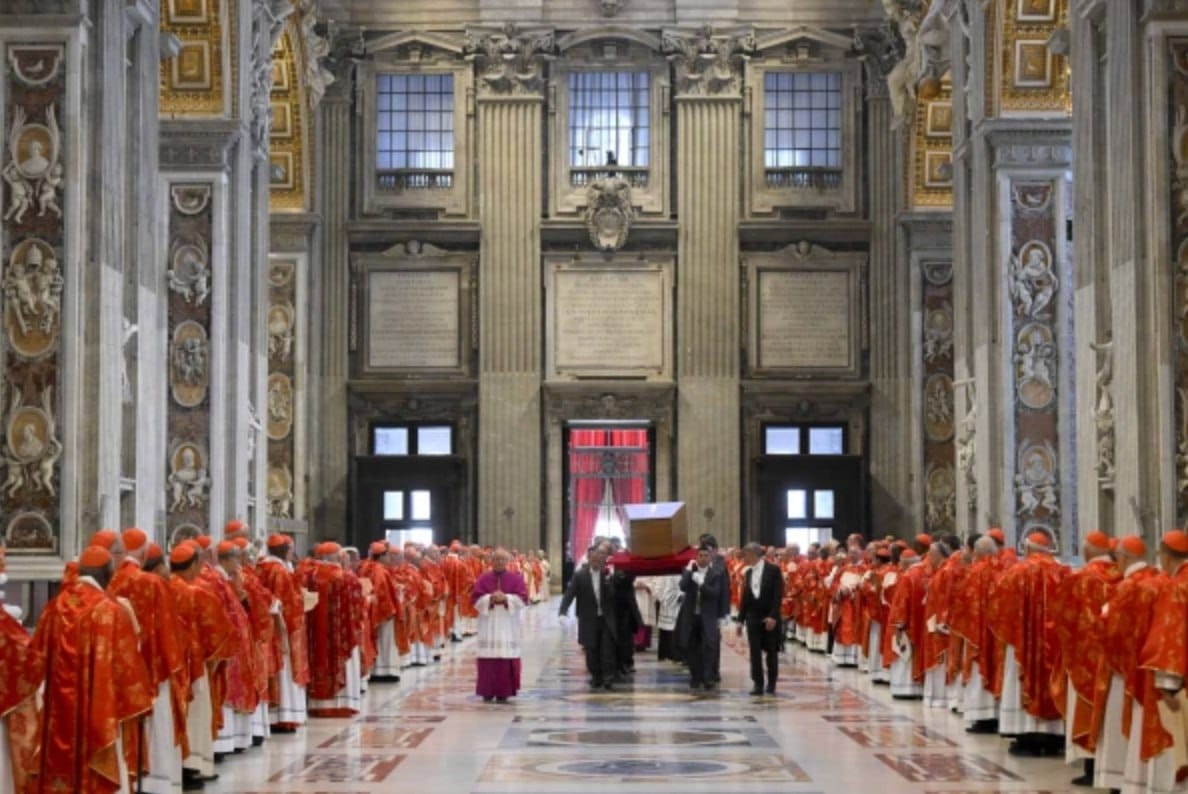
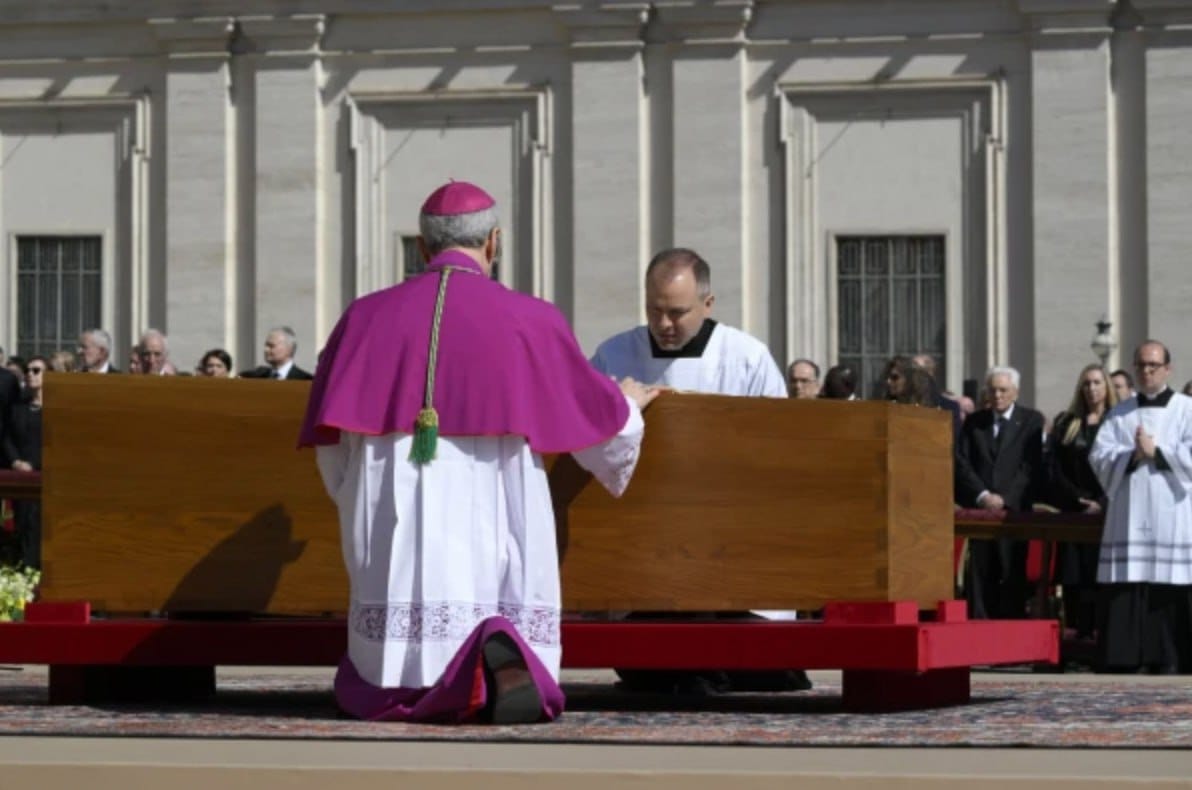
During the ceremony the coffin with the body of Francis was carried out of the basilica to applause, and an open Gospel was laid upon it. The homilies were accompanied by the applause of those gathered. In the photograph, Archbishop Diego Giovanni Ravelli kneels beside the coffin, while Cardinal Giovanni Battista Re censes it.
The funeral was conducted in a simplified form, at the wish of Francis himself.
The Pope was buried in a single wooden coffin instead of the three traditionally prescribed, made of cypress, lead and oak.
The lying in state took place in the chapel of the Apostolic Palace rather than in the pontiff's apartments.
The body was displayed in the coffin, not on a pompous catafalque without one.
After the ceremony the body was conveyed to the Basilica of Santa Maria Maggiore in Rome for burial, in accordance with the will of Francis, who became the first pope since 1903 to be buried outside the Vatican.
This church is associated with the Jesuit order, to which the pontiff belonged. The burial ceremony was private. The coffin with the body of Pope Francis was sealed by Vatican officials in the presence of Cardinal Kevin Farrell.
Several other Popes are buried in the Basilica of Santa Maria Maggiore: Pius V, Clement VIII, Clement IX, Paul V and Sixtus V, as well as such well-known figures as Napoleon Bonaparte's sister Pauline, and the outstanding Baroque architect and sculptor Gian Lorenzo Bernini. The basilica also keeps the relics of the Apostle Matthew, part of the relics of the Apostle Epaphras, of Blessed Jerome of Stridon, of the venerable Redemita and of Saint Romulus, part of the cradle of Jesus Christ, the Byzantine icon of the Mother of God “Salus Populi Romani” (“Salvation of the Roman People”), the Holy Door and the triumphal column of the Virgin and Child brought from the Roman Forum.
The niche in which the coffin of Pope Francis is sealed lies between the chapel where Paolina Bonaparte is buried and the Sforza Chapel, associated with the names of Michelangelo and Giacomo della Porta.
On the day of the funeral unprecedented security measures were in force in Rome: a no-fly zone over the Vatican, snipers on the rooftops and heightened controls.
After the funeral the period of sede vacante, the vacant see, began, in preparation for the conclave, which has been appointed for 6–12 May 2025 to elect the new Pope.
The funeral took place in a traditional yet simplified form, with great international attention and respect for the will of the late pontiff.