I drew a very lucky ticket in my fate, because at the end of 1944, while the war was still going on, I was sent to the Moscow Choir School
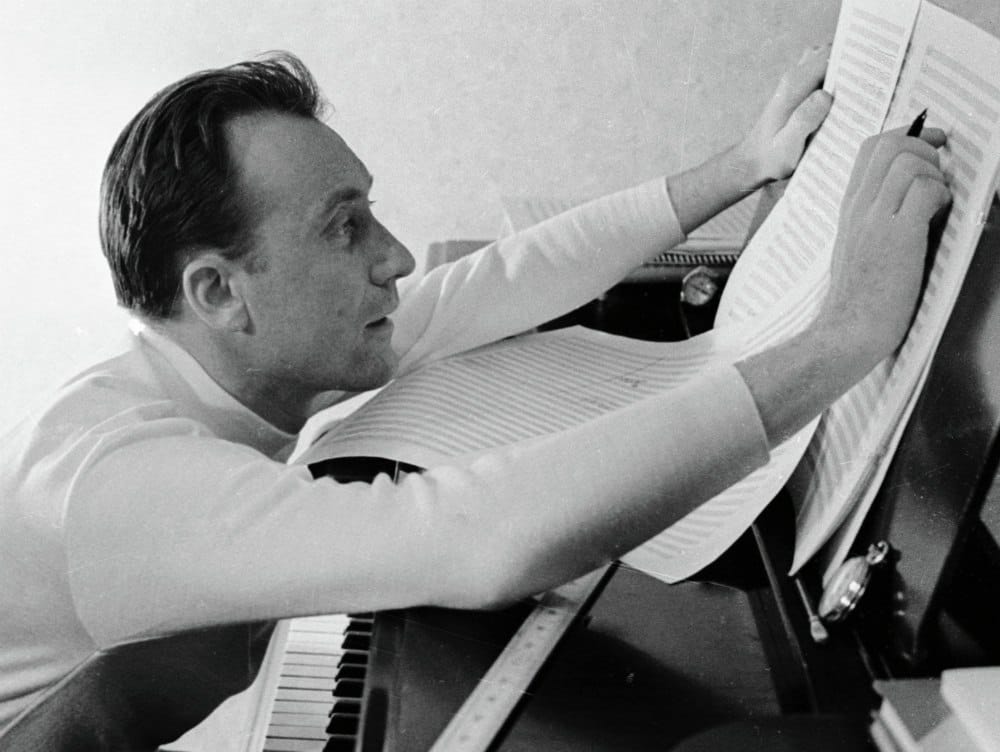
I drew a very lucky ticket in my fate, because at the end of 1944, while the war was still going on, I was sent to the Moscow Choir School. This was preceded by the wartime years and then a rather painful evacuation. My father had already sent my papers to the Nakhimov Naval School in Leningrad, because I had problems, let us say, with my behaviour.
As my father was a professional musician, he naturally wanted me to study music, and so he showed me to the then director, Alexander Vasilyevich Sveshnikov. The school had a boarding house. On top of that, we went about in a semi-military uniform, in little dark blue tunics with gold buttons. And somehow that appealed to me very much. I lived there for 6 years in the boarding house and sang in the choir every day for an hour and a half.
If you leaned against the wall, or against a comrade, or against the piano, our director, who had long fingers, would hit you painfully and imperceptibly on the collarbone. And in case of need we had a housemaster, a former cadet, Vadim Alexandrovich Belyaev, who would stand us on guard duty in the cold cellar. And when that day came… It was already 11 February 1948. We had a solfeggio lesson, and our teacher was Alexei Alexeyevich Sergeyev. He lined us up in the choir hall. We called him “the old Communist”. And he began to tell us what a happy day had at last arrived, one that he had been awaiting almost since the day of his birth: those wretched formalists had been condemned. And I got it too, because I had already begun to write music. A competition had been organised at the choir school; Sveshnikov himself greatly encouraged composition, and our naive pieces were performed by our own choir. There was a competition chaired by Aram Ilyich Khachaturian. And I won first prize in that competition.
Beethoven, let us say, was enormously helped by wealthy Russians. I will not even mention those quartets, the so-called Razumovsky quartets. But his famous Fifth and Sixth Symphonies, with that theme of fate which Gaidai used in his film, were written and dedicated to Count Andrey Kirillovich Razumovsky in gratitude for his financial support. How do you like that? And more than that, I will tell you that Beethoven’s famous Missa Solemnis was first performed in Saint Petersburg with the financial support of Prince Golitsyn.
Bach was commissioned by Frederick II, who played the flute and was renowned for it in his royal circle. He invited Bach so that Bach might improvise in his presence, was utterly astounded, and even granted him a certain sum of money. And, let us say, a First Secretary of the Central Committee, who I do not think played the flute.
Bach wrote his greatest Brandenburg Concertos, dedicating them to the Margrave of Brandenburg with an extremely obsequious, lengthy dedication, you understand? But Tchaikovsky, after all, received from Alexander III a pension of 3 thousand in gold, you understand? And on the other hand, Tsar Nicholas financed Gogol, who received a stipend through the patronage of Zhukovsky. I consider that this helped the history of art. Of course, it is a pity that Schubert never heard in his lifetime a single note of his symphonies, of which he has 9.
In 1968 I refused to sign the letter when our troops were being sent into Czechoslovakia, and the “Voice of America” reported it. And storm clouds gathered heavily over me. I left the Conservatoire, where I was already teaching, slamming the door. But the centenary of Lenin was just approaching, and I did as my very close friend Andrei Voznesensky did, who wrote “Longjumeau”. Simply so as to get out of this difficult situation with honour somehow. And I think that I did get out with honour, because the texts of the oratorio were documentary reminiscences.
One of the parts consisted of the reminiscences of Lenin’s bodyguard, a certain Belmas. He was a Latvian rifleman. And he telephoned me, in an old man’s voice, because something had appeared in the newspapers, and said: “Oh, I could not come to the concert, I do not leave the house. But I will tell you, come and see me, there are many more additions.” And secondly, Lyudmila Zykina took part in this work, singing. And afterwards it was performed in Berlin, in Paris, in London, everywhere, with success.
The composer Rodion Shchedrin (1932-2025) in an interview with Vladimir Pozner