Homo homini amicus, collega et frater est: Man Is to Man a Friend, Comrade and Brother
The historian of antiquity Mark Naumovich Botvinnik (1917-1994) recalls Stalin's post-war reforms as an attempt by an ageing leader to bring back the feeling of youth.
Old people begin to fancy that when they were young everything was much better: the snow was whiter, the water clearer, the sausage tastier. Such an old man, after the war, was the all-powerful dictator of Russia, Joseph Vissarionovich Stalin. Old age was drawing nearer and nearer. There remained a faint hope that the feeling of youth might return if everything around him took on the very forms that had once surrounded him.
The era of post-war reforms, which was never brought to completion, lodged in Botvinnik's memory not only for the introduction of shoulder-boards, officers' ranks and the institution of batmen, and for the styling of the militia uniform after the kit of the tsarist-era city constables, but also for innovations in the system of secondary education: in particular, the division of schools into boys' and girls' schools and, unexpectedly, the introduction of Latin.
The project began to be put into effect in 1948. Stalin, who had studied at a theological seminary, knew that in many Russian schools, the gymnasia, the ancient languages, Latin among them, had been taught. And so, obedient to every twitch of the leader's eyebrows, the ministers of education, first Potemkin and then Voznesensky, issued circulars on introducing the Latin language into the curriculum of the upper forms of certain schools in large cities.
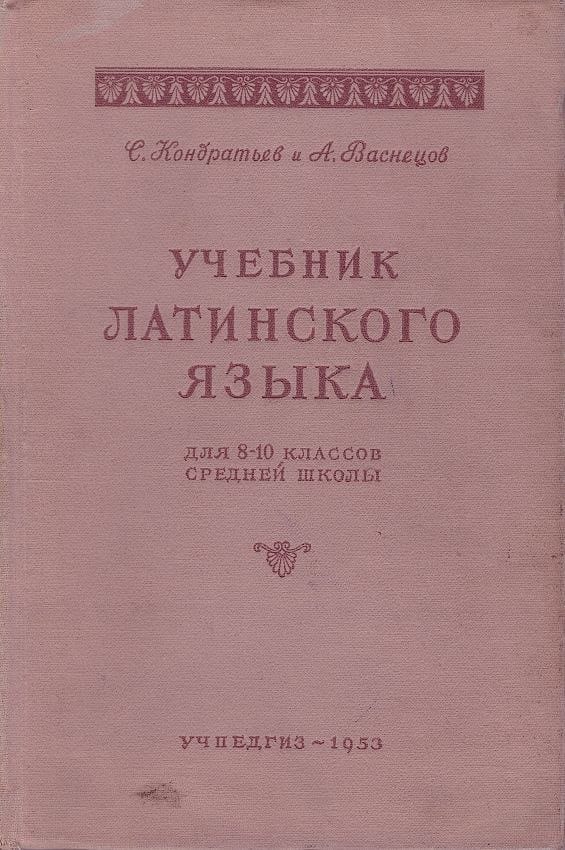
The experienced Latinist Sergey Petrovich Kondratyev was drawn in to compile the school textbook; in 1948 he wrote the “Textbook of the Latin Language for Forms 8-10 of the Secondary School” [«Учебник латинского языка для 8-10 классов средней школы»], which differed little from the pre-revolutionary gymnasium and seminary textbooks of Sanchursky and Mikhailovsky.
However, a new ideology was introduced into the old texts, and they were politicised wherever possible.
The alterations looked rather amusing: for example, the saying “Man is wolf to man” (Homo homini lupus est) turned into “Man is to man a friend, comrade and brother” (Homo homini amicus, collega et frater est). The bellicose Roman dictum “If you want peace, prepare for war” (Si vis pacem, para bellum) now became consonant with state propaganda: “If you want peace, prepare peace” (Si vis pacem, para pacem).
The textbooks were published with greater ease than ready-made teachers could be found. In Leningrad, in that same year of 1948, Latin was introduced in all the eighth forms of four schools, nos. 189, 203, 216 and 320, and moreover without division into groups, which complicated the teaching.
The order had to be carried out, and the departments of public education handed the teaching of Latin over to old teachers who had once graduated from gymnasia. In thirty years these very old people had managed to forget a great deal, but weekly classes were organised for them at the Institute for the Advanced Training of Teachers.
Were schoolchildren and their parents delighted at the appearance of a new subject? In those years the dream was a technical profession, and the lads would have preferred extra hours of mathematics and physics to difficult Latin, which not only conferred no advantage on admission to higher education but was not even entered on the school-leaving certificate.
The undertaking did not meet with success, and by the mid-1950s Latin had already vanished from the school curriculum. But in return the Soviet Union had a whole generation of school-leavers who remembered that
Si vis pacem, para pacem
If you want peace, prepare peace
📌Parnassian Mockingbird - Subscribe📌