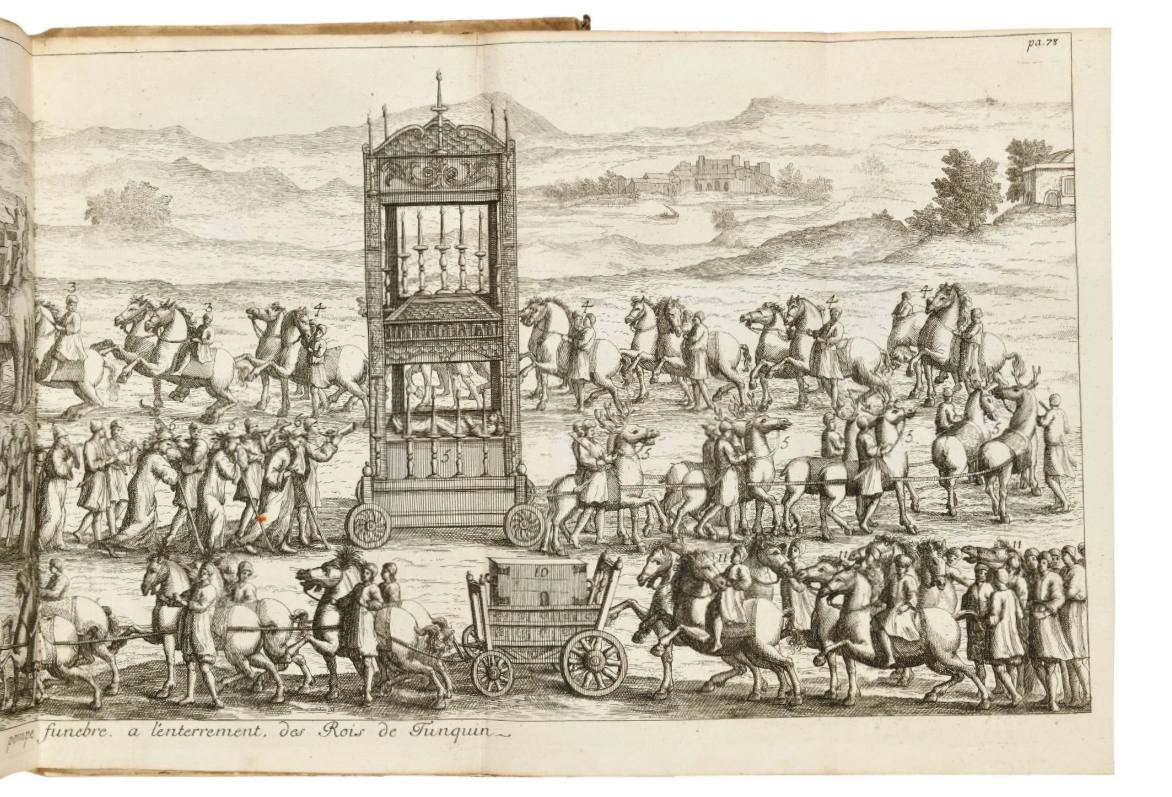
Engraving of the funeral procession of the kings of Tonkin, Jean-Baptiste Tavernier, "Six Voyages Made by Him in Turkey, Persia and the Indies", Paris, 1677, with the supplement "Continuation of the Voyages", 1679
Jean-Baptiste Tavernier was the son of a map engraver, became a dealer in precious stones and from 1623 crossed the road from Paris to Persia, and onward into India, six times. He traded at the courts of the Great Mughals and brought back from India a diamond that later became known as the "Tavernier Blue" and eventually turned into the "Hope Diamond". In 1677 he published his travel notes.
This engraving, from the supplementary volume of 1679, which contains among other things a "New and Unusual Account of the Kingdom of Tonkin", depicts the funeral procession of the kings of Tonkin. At the centre stands a tall funeral palanquin on wheels, adorned with a canopy and carving. It is drawn by horses, with attendants on foot in white garments around it and horsemen galloping along the edges. State mourning, as you can see, is associated with white rather than black.
Tavernier himself never went to Tonkin. The essay on the Kingdom of Tonkin entered his book as a separate section, compiled from the testimony of others. Europe at that time was only beginning to assemble its notions of South-East Asia piece by piece, and such books, with their engravings and descriptions of foreign rites, became the principal source of both politico-geographical information and cultural and ethnographic material.