Stolnik Pyotr Tolstoy describes Venetian gondolas, how they were built and hired
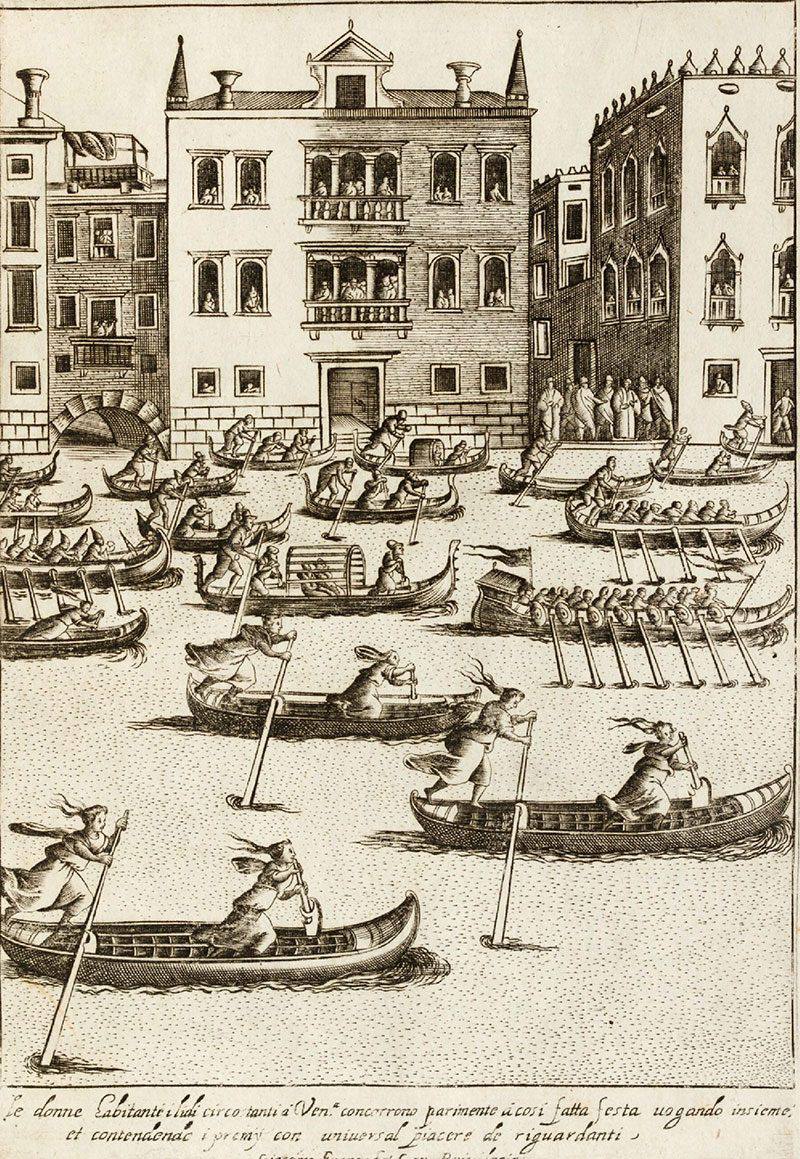
Gondoliers in Venice are an exclusively male profession, but if this engraving of 1610 is to be believed, women were also admitted to the traditional gondola race.
A Russian traveller of that time, the stolnik Pyotr Tolstoy, describes what he saw in Venice as follows:
In Venice there are hackney boats, which they call gundalas, many thousands of them, and all black and covered with black cloth, with great windows, and in every gundala there is one man to row, and in some two men. And whoever needs to travel by sea to places near Venice, or in Venice itself along the canals, that is, along the streets, goes in those gundalas, hiring them; and the fare for a whole day is, for a gundala with one oarsman, a Venetian ducat, which in Moscow money is 15 altyns; and for that fare he is bound to carry you the whole day, wherever you please.
And the Venetian procurators and notable merchants, and likewise the clergy, have their own gundalas, of which there are in Venice not one thousand only. Many of those gundalas are richly adorned, of carved work, gilded, covered with velvets with laces and with fringes of gold thread and other handsome brocades, and with great windows; and they are also furnished with tapestries, or coloured tripe velvets, or other handsome brocades of the like kind.
And those gundalas are built in a fashion of their own: long but not wide, as single-log dugouts are, and the prow and stern are pointed, and on the prow are great iron combs, and the stern is likewise bound with iron, and in the middle is built a cabin with windows, covered with handsome curtains, and in it are handsome benches with cushions. And the oarsmen are one man at the prow and another at the stern; and in a gundala that has no second oarsman, there is one man at the stern, who rows standing, and steers with the same oar, and there is no steering oar at the stern, as there usually is, on those gundalas, yet they steer handsomely without it.