"That little dog was my only comfort

"That little dog was my only comfort. Carlo slept with me, and in the daytime never left my side for a step, and what clever eyes he had, as though he understood everything. Well, the other day I gathered some scraps by the kitchen and was feeding him, and the master saw me and said: 'You are feeding him at my expense! If all my Negroes take it into their heads to keep dogs, I shall be ruined.' He ordered a stone to be tied round his neck and him to be drowned in the pond."
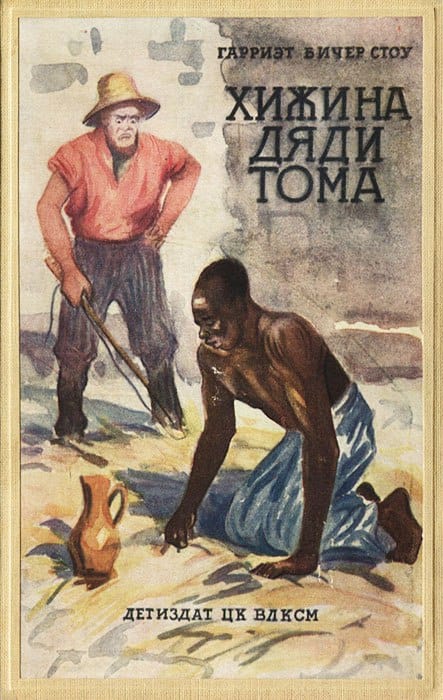
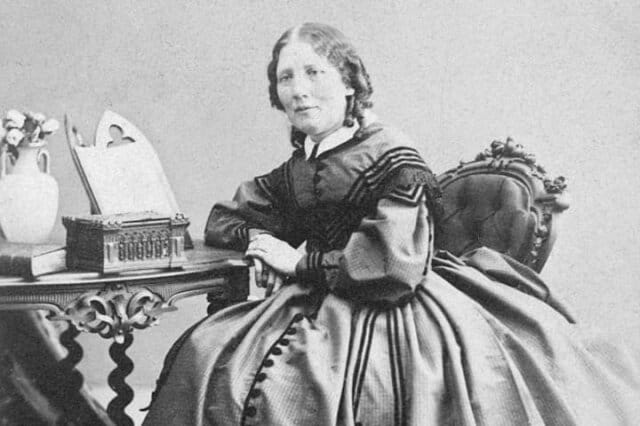
The American writer Harriet Beecher Stowe (1811-1896) describes in her novel Uncle Tom's Cabin; or, Life Among the Lowly how a cruel, inhuman and envious master forces his gifted slave George to drown his dog. But what do we see? George refuses to carry out the order; he does not tie a stone round his friend's neck, as the slave-owning monster demands.
Alas, the dog perishes all the same:
"They threw poor Carlo into the water, he and Tom, and pelted him with stones, and he looked at me so piteously, as if to ask: 'Why do you not save me?..' Again I was beaten, for refusing to drown him."
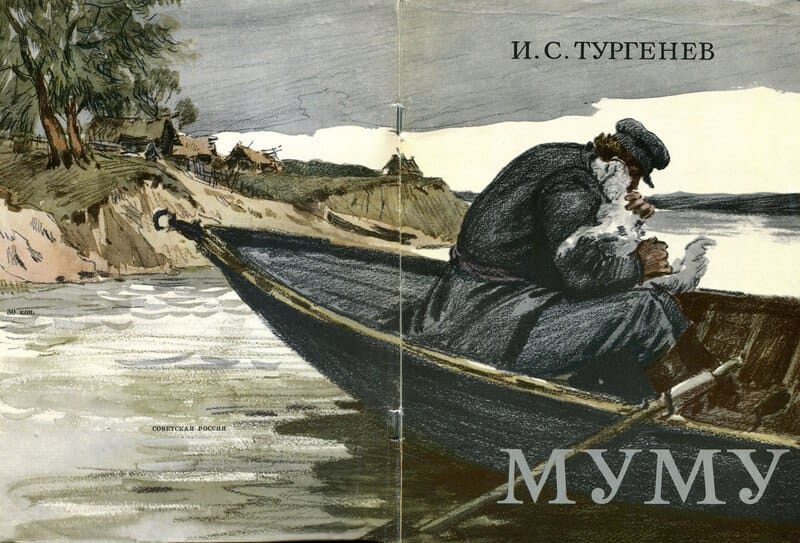
An incredible coincidence with the key scene of Turgenev's (1818-1883) story Mumu. But how could this have come about, given that Uncle Tom's Cabin was published two years before Mumu, in 1852, and appeared in Russian as early as 1853? It is also known that Turgenev was acquainted with the novel. Before drawing any conclusion, one must take into account that the events described by Turgenev in Mumu, including the drowning of the dog, rest not on literary invention or borrowing but on a real incident at the estate of Turgenev's mother, who ordered the mute yard-keeper Andrey to drown his beloved dog. He carried out the sentence and, unlike Gerasim, did not leave his mistress afterwards but went on with his servile duty. Perhaps it was precisely on reading Beecher Stowe that Turgenev recalled this tragic episode from his family's life? Or perhaps the appearance in literature of these two storylines is connected by nothing but their grotesque, ugly and at once tragic character, which exposes the very essence of slavery.
But this is not the only resemblance between the texts of Beecher Stowe and Turgenev. One may notice something in common between Akim in Turgenev's The Inn, written in the same year, 1852, and Uncle Tom. Here any borrowing is out of the question, since the texts were written simultaneously. Turgenev's acquaintance with the American novel came only after the publication of The Inn, as his letters confirm, along with his surprise at the kinship of the heroes.
In this case, too, the likeness of the heroes is striking: Akim, like Uncle Tom, falls victim to an unjust sale. But whereas in Beecher Stowe it is Uncle Tom himself who is sold to a dreadful trader, which proves fatal for him, in Turgenev the lady sells the inn that Akim built on her land, and moreover for money stolen from Akim by a scoundrelly huckster, who takes possession both of Akim's wife and of his one solace, the inn. Both protagonists stand at the zenith of tragedy, and both are good, devout men. Yet Turgenev's text is unquestionably superior in artistic merit and subtle psychology, whereas Beecher Stowe concentrates her creative energies on the social subtext.