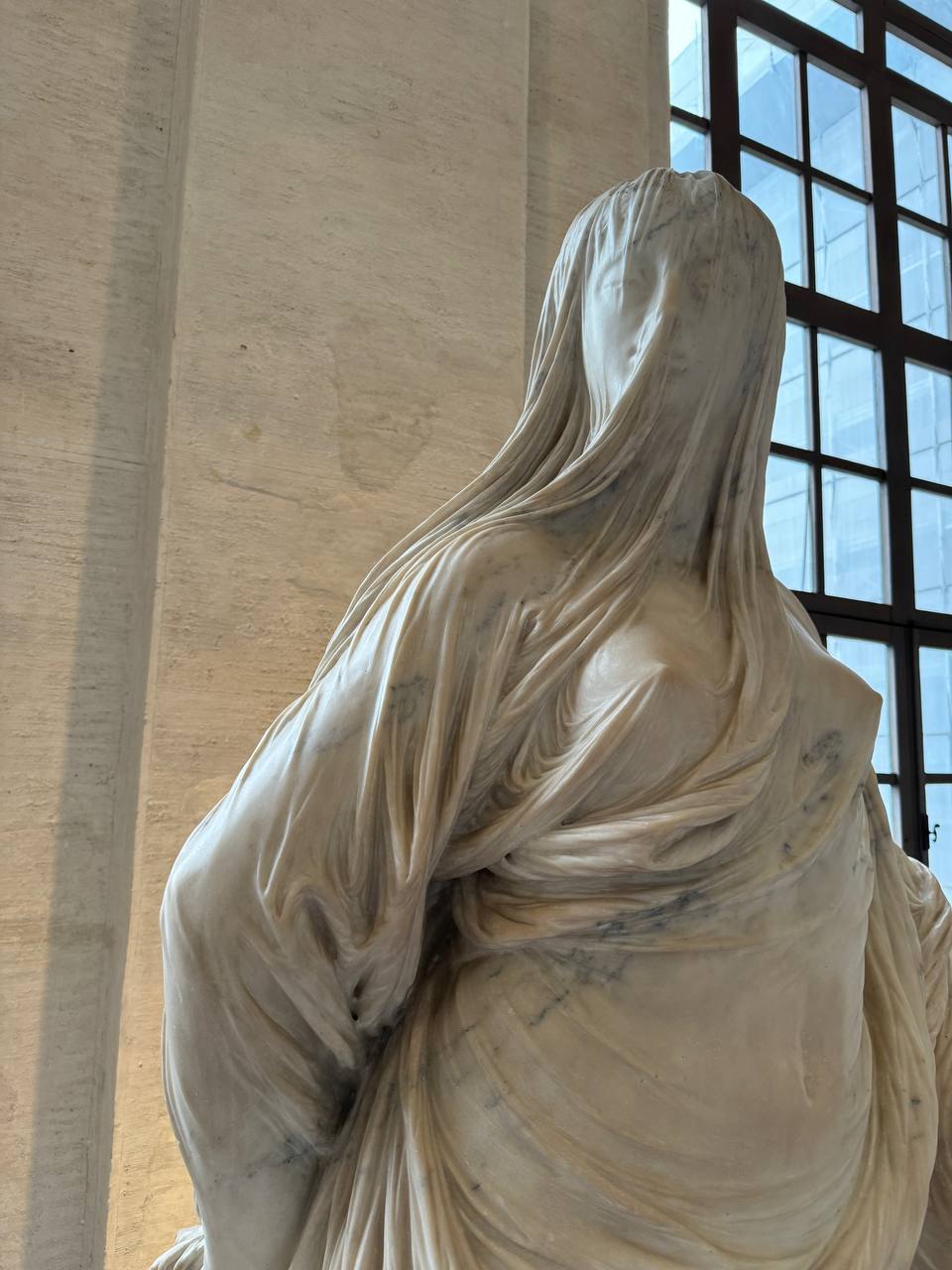
Marble Vestal Tuccia by Antonio Corradini, 1743, in Palazzo Barberini
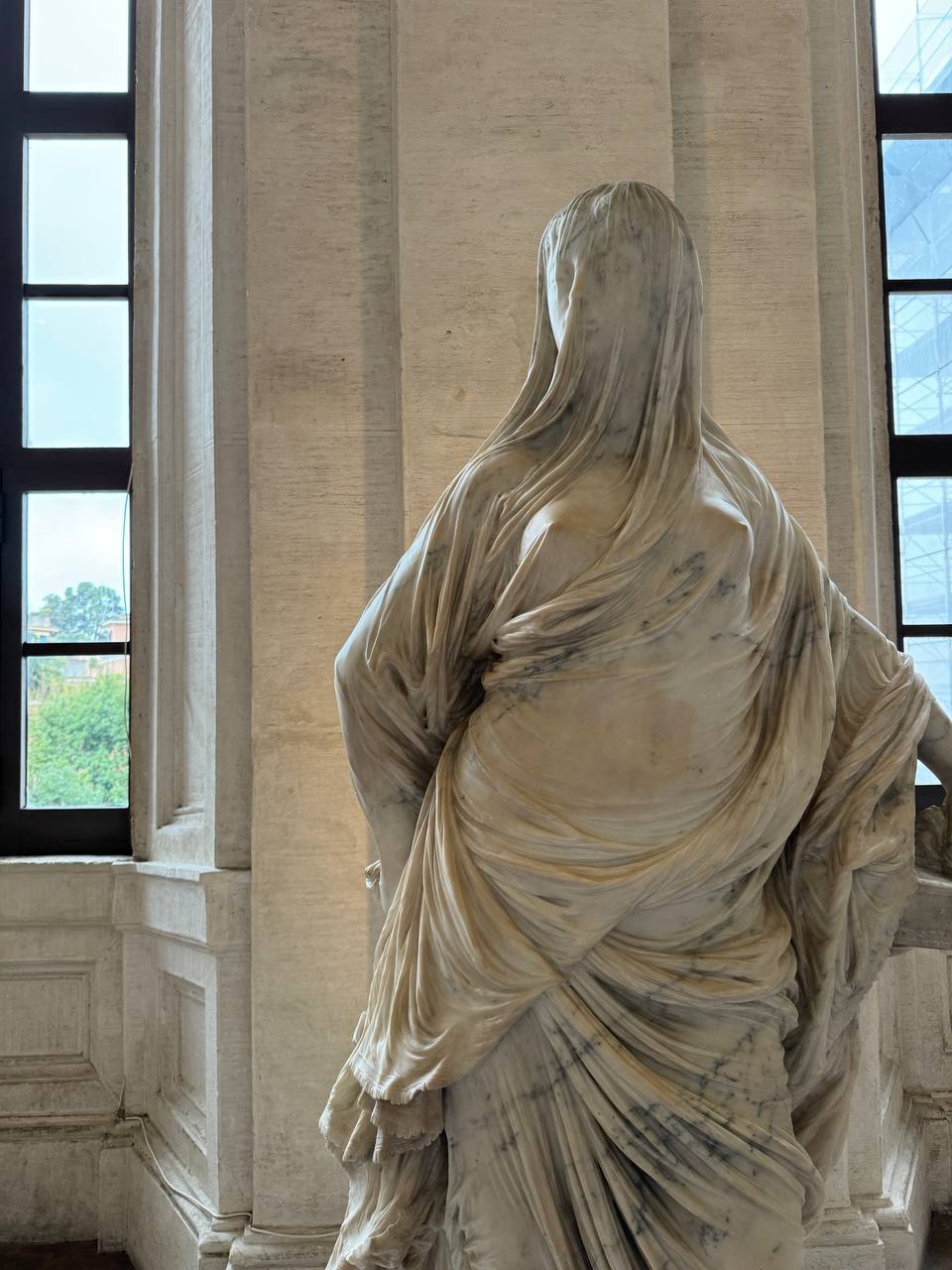
This veiled marble maiden is one of the celebrated sculptural series of her day. She was created by Antonio Corradini in 1743.
Her maker was, in a manner of speaking, the darling of the European courts: sovereigns and aristocrats alike longed to possess his work. Above all, Corradini specialised in veiled female figures, whose production he organised most efficiently, and thanks to the high quality of the execution and the exotic form he made them a veritable sensation. Connoisseurs of refined taste who came to Rome begged admittance to Corradini's studio to gaze upon the marvellous beauties, their piquant parts covered by “wet” veils. So did James III Stuart, the pretender to the English throne, well known for his love of the arts.
The “wet” mantle of the marble maiden drew raptures from her contemporaries as an example of flawless illusionist mastery.
Of particular interest is the identity of the heroine hidden beneath so close-fitting a fabric. Corradini portrayed the ancient Roman Vestal Tuccia (or Tucca), unjustly accused of breaking her vow of chastity. In proof of her innocence she miraculously carried water from the Tiber to the Roman Forum in a sieve, spilling nothing, and poured out the sieve at the feet of the pontiffs.
The sculpture is displayed on the staircase landing of the Palazzo Barberini. But, to be honest, as sometimes happens, in the flesh (or rather, in the marble) she loses a great deal to the pictures in albums and on the internet and to the multitude of rapturous descriptions. The bosom looks handsome, but the poorly worked face recalls a slightly bloated death mask rather than a Vestal brimming with beauty and life. One could easily walk past the statue without paying particular attention to the almost unbroken drapery with its marble swirls. The charm one expects, if one knows Corradini's works only from static images, dissipates on viewing them in person, especially if one compares his level with the talent of Bernini himself, which can be done quite easily by looking in at the nearby Villa Borghese. Such are the wonders that fashion and advertising work