Elizaveta Petrovna, as is well known, though a daughter of Peter the Great, was born out of wedlock, like her elder sisters Ekaterina Petrovna and Anna Petrovna: all of them were born to Catherine before the wedding in 1712 and were considered "legitimate
Elizaveta Petrovna, as is well known, though a daughter of Peter the Great, was born out of wedlock, like her elder sisters Ekaterina Petrovna and Anna Petrovna: all of them were born to Catherine before the wedding in 1712 and were considered "legitimated by marriage". Elizaveta had no right to the throne, and so she had to resort to a coup d'état.
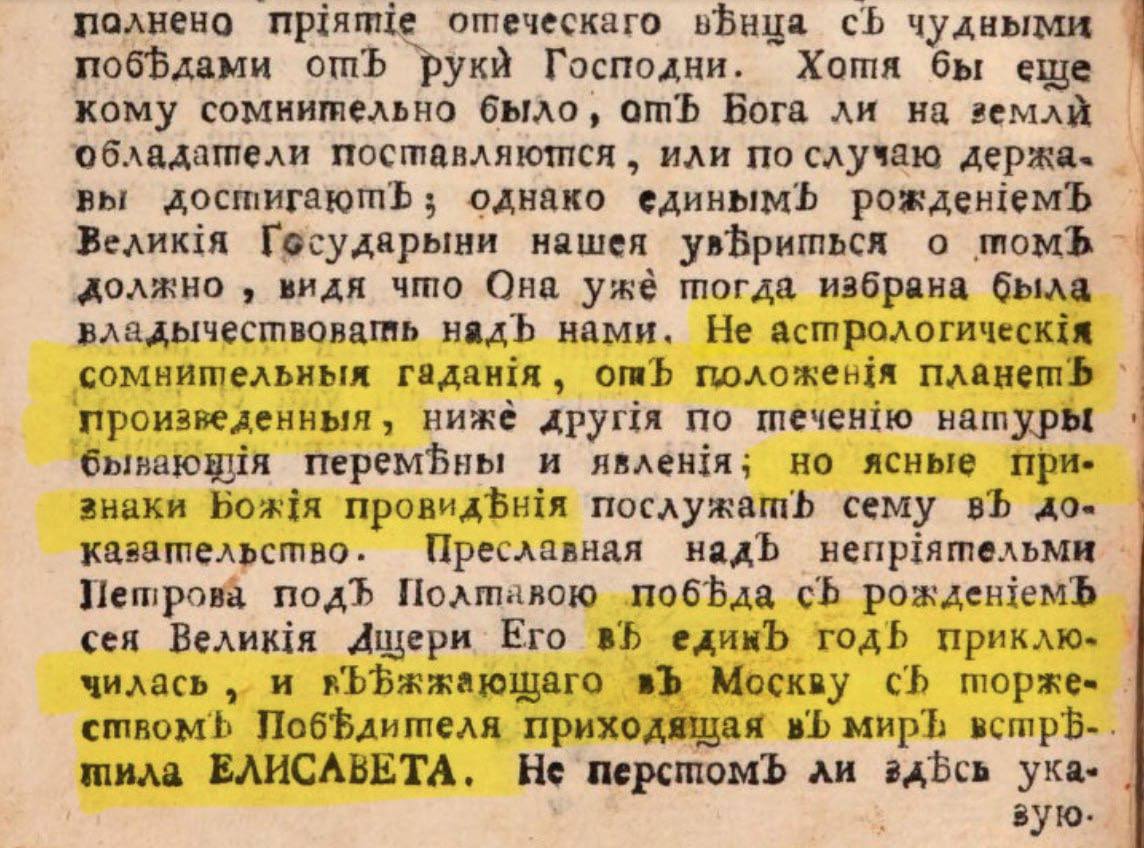
Lomonosov found an interesting argument in favour of the legitimacy of Elizaveta Petrovna's accession. In his "Panegyric to the Most Serene, Most Sovereign Great Lady, the Empress..." he writes as follows:
"...by the very birth of our great sovereign lady one must be assured of this, seeing that she was even then chosen to rule over us. Not doubtful astrological divinations, drawn from the position of the planets, nor other changes and phenomena that occur in the course of nature, but the clear signs of Divine Providence shall serve as proof of it. The glorious victory over Peter's enemies at Poltava befell in one year with the birth of this great daughter of his, and as the victor entered Moscow in triumph, Elisaveta, coming into the world, met him. Is it not Providence that here points with its finger? Do we not hear with the ear of the mind a speaking voice? See, see the fulfilment of what was promised you by the portents of prosperity. Peter triumphed, having vanquished foreign enemies and rooted out traitors of his own; Elisaveta was born for like triumphs. Peter, having restored the crown to the lawful sovereign, proceeded to the city of his fathers; Elisaveta entered human society so as afterwards to regain for herself her father's crown. Peter, having preserved Russia from plunder, brought in place of gloomy fear a secure and most radiant joy; Elisaveta saw the light in order to pour upon us the radiance of consolation, delivering us from the gloom of sorrows. Peter led behind him numerous captives, vanquished no less by his magnanimity than by his courage; Elisaveta was delivered from the womb so that afterwards she might captivate the hearts of her subjects with humanity, meekness and generosity...".