Maurizio Forte and Jacqueline Ortoleva measure the acoustics of two Etruscan tombs in Tarquinia
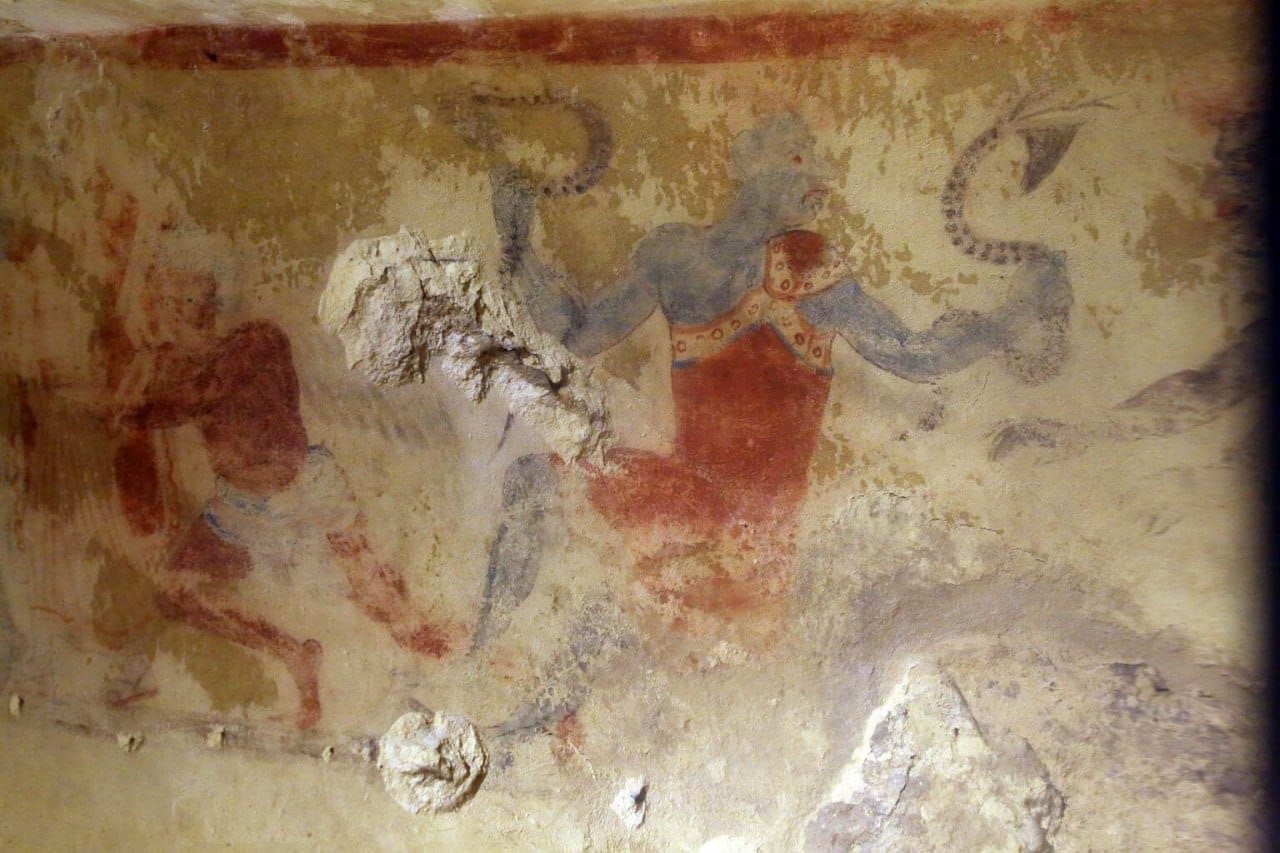
The acoustics of Etruscan tombs have become the subject of a study.
Etruscan chamber tombs were family vaults, and they were opened afresh for every new burial. Funeral rites with feasting, dancing and games are depicted in many of the paintings. The relatives of the deceased returned to these tombs for seasonal rites and the veneration of ancestors, and the tomb was meant to make a powerful impression on them.
Hitherto they have been studied only as painting and architecture, while nobody has measured the sound inside. The archaeologists Maurizio Forte of Duke University and Jacqueline Ortoleva of Oxford have for the first time measured how painted Etruscan tombs sound. They examined two tombs of the fifth century BC at Tarquinia and found that these tombs created for their visitors entirely different sound environments.
Archaeologists usually study tomb paintings as flat images. Forte and Ortoleva studied the tombs as a space in which a person moves, looks and listens. They built three-dimensional models of the tombs and played back recorded handclaps at various points in order to measure the reverberation time, that is, the time it takes for the echo to die away. Separately, the researchers used computer vision to determine which paintings first come into the field of view of a person entering the chamber.
The Tomba del Gallo (Tomb of the Cockerel) depicts feasts, musicians and dancers. The layout of the chamber shows the paintings to the visitor in a particular order. Sound here escapes quickly, and the echo dies away within a second or a second and a half. In the authors' opinion, this muted acoustic did not distract the visitor, and the main impression in this tomb was made by the images.
The Tomba dei Demoni Azzurri (Tomb of the Blue Demons) is almost four times as large, and the echo in it takes more than seven seconds to fade. The researchers compare its reverberation with that of St Paul's Cathedral in London. Voices, drums and rattles were reflected many times off the walls, while in the half-light the visitor saw images of demons, who among the Etruscans personified the underworld. The authors believe that such a combination left visitors disoriented and, in certain conditions, in a state close to a trance.
In my view, the conclusions of the study are rather far-fetched. Such sonic intent on the part of the builders is not merely unproven; it cannot be proved by measurements alone. Acoustics, naturally, arise from, and follow, the size and shape of the chamber.