Waldner's Aero-Train: The Soviet Train of the Future That Never Went Anywhere
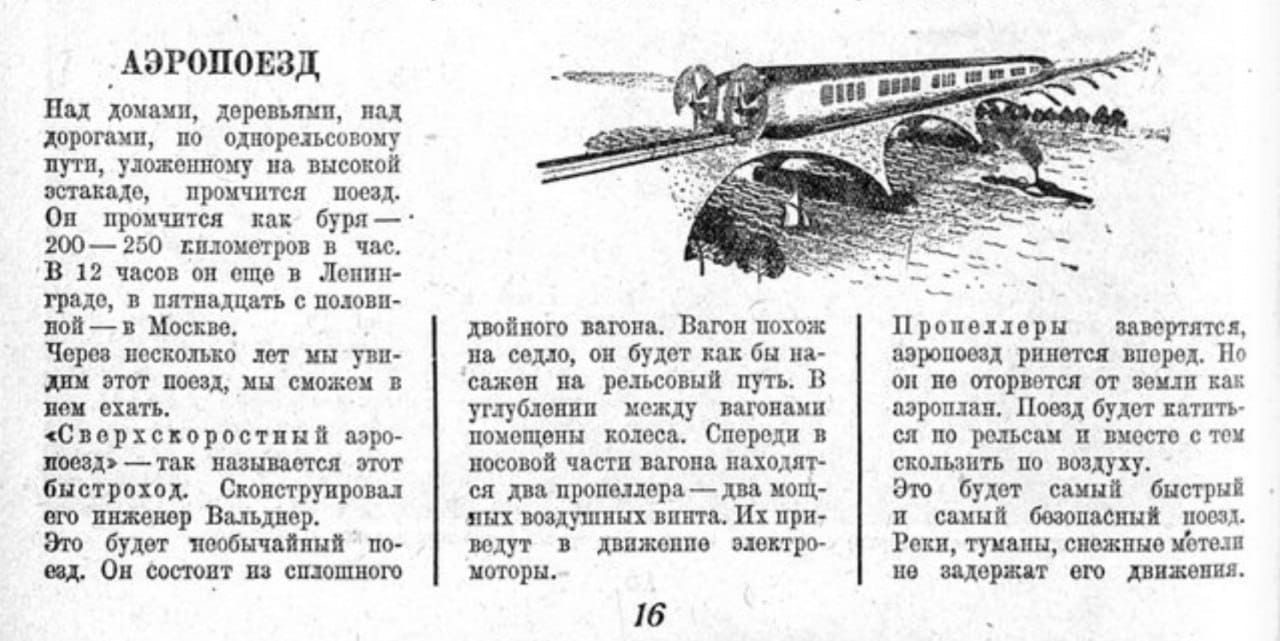
Sevastyan Waldner received a musical education and played the violin, but he entered history as the inventor of a monorail train that was half a century ahead of its time. In 1931 he began work on the aero-train: two streamlined gondolas on a triangular truss, 300 passengers, a projected speed of 250-300 km/h. Tupolev and specialists of TsAGI were brought into the project, serious people with serious instruments.
In 1933 a test trestle almost half a kilometre long appeared in Gorky Park. A scale model ran confidently along both straight and curved sections, and the snow blew off the structure of its own accord; that is, when the city's trams stood helpless in the drifts, the aero-train could have gone on running.
The American Popular Science published a rapturous article and called it an “amphibious train”: at river crossings the carriages were simply to float across the water, with no need to build bridges.
The first line, 1,500 km long, was planned in Turkmenistan, and preparations for construction were under way in earnest. And then in 1934 the project was quietly closed without any public comment, supposedly in favour of the development of aviation.
Waldner continued his career in other branches of railway engineering and never returned to his main idea.
High-speed monorails became an everyday reality in Japan, China and Germany only forty years after a Soviet violinist had thought it all up.
But Waldner's aero-train was not the first invention of its kind. Before it, the Abakovsky aerowagon had already been invented, prototyped and tested in 1921. In the course of trials the aerowagon covered more than three thousand kilometres without accident, showed a high speed of 140 km/h and economical fuel consumption. But on 24 July 1921, when about twenty people headed by the well-known Bolshevik Comrade Artyom set off in it for Tula to meet the miners, at 18:35, roughly 110 kilometres from Moscow, near Serpukhov, at a speed of about 85 km/h the aerowagon left the rails. Of the 22 people aboard, seven were killed, among them Comrade Artyom and the 25-year-old designer Abakovsky; both were buried by the Kremlin Wall