Last year the Prado Museum reattributed the painting "The Colossus" as a work by Francisco Goya of 1808-12
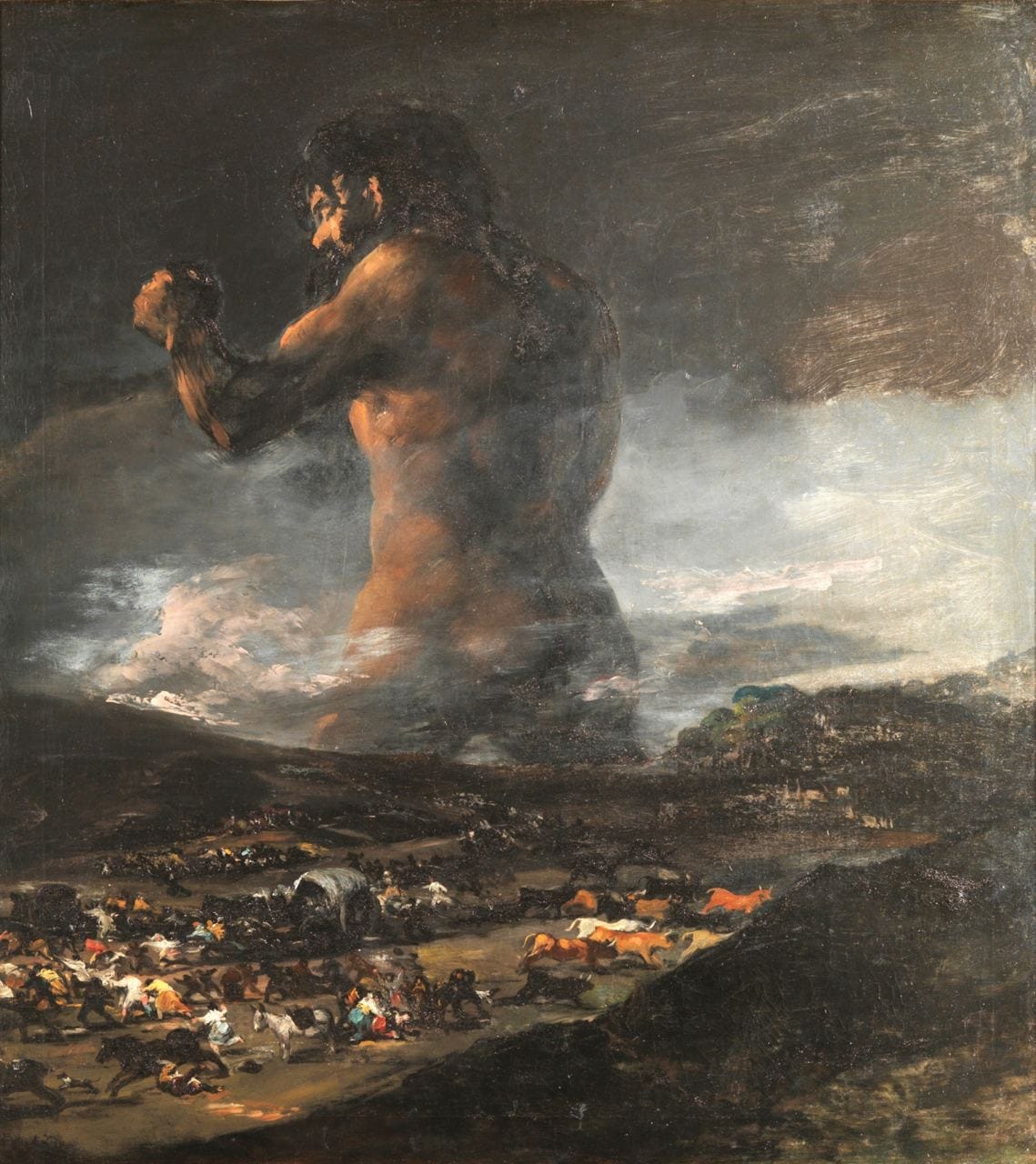
Last year the Prado Museum reattributed the painting "The Colossus" as a work by Francisco Goya of 1808-12. A naked giant with a clenched fist, standing before a field of scattering people, may, in the view of art historians, symbolise the struggle against Napoleon's army. If this version is to be believed, then the giant rising from behind the mountains is the Spanish people, rising in the Pyrenees and ready to fight for their homeland with bare hands. The subject follows the poem "The Pyrenean Prophecy" by Juan Bautista Arriaza of 1810. In general, Spanish patriotic poetry often resorts to the image of giant heroes defending the fatherland. The enemy, in theory, is out of sight, beyond the mountain ranges, along which the peaceful inhabitants flee for safety. One motionless figure can be noticed: a donkey standing rooted to the spot, which either alludes to incomprehension of the horrors of war or depicts a fossilised aristocracy that takes no measures whatever. According to other versions, the giant may represent the Spanish monarchy standing against Napoleon, which is most improbable, given its incompetence and arrogance