Between 2010 and 2020, the world's religious landscape changed considerably
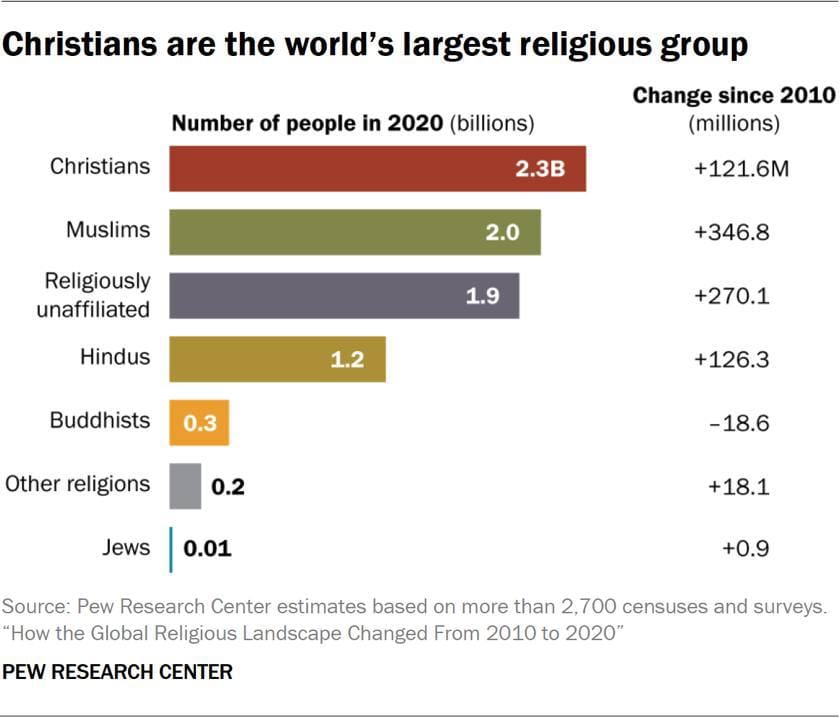
Between 2010 and 2020, the world's religious landscape changed considerably. Here are some statistics from the latest report by the Pew Research Center:
Christianity remains the largest religion in the world: over the decade the number of Christians grew by 122 million, reaching 2.3 billion by 2020. The growth in the number of Muslims, however, was almost three times as great: 327 million new adherents. The total number of Muslims reached 2 billion. This is more than the growth of all other religious groups put together. Such growth is due, above all, to a high birth rate.
Apart from Islam, only one group increased its share of the world's population: the religiously unaffiliated, who identify with no religion at all. By 2020 their share had reached 24.2% of the Earth's population, making them the third largest group after Christians and Muslims.
The greatest change in share of population over these ten years was experienced by Christianity itself. If in 2010 the bulk of Christians (25.8%) lived in Europe, by 2020 the centre of Christianity had shifted to sub-Saharan Africa, which is now home to 30.7% of all the world's Christians. This is the result both of natural population growth in the region and of the mass abandonment of religion in Western Europe. By way of comparison: at the beginning of the twentieth century only 1% of the world's Christians lived in the countries of sub-Saharan Africa, while two thirds lived in Europe.