In April 1917, on the eve of the April Crisis, which through Milyukov's note would bring down the first Provisional Government, the chief political topic in Moscow was the "Liberty Loan", that is, the Provisional Government's war loan to continue the war
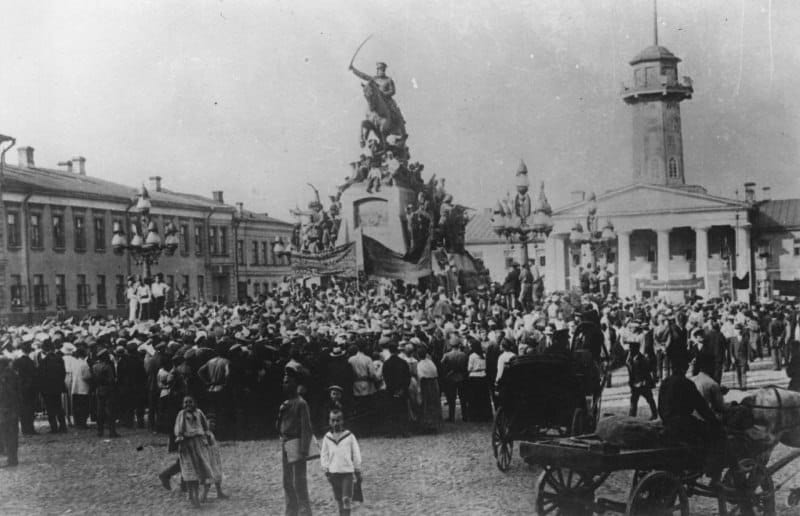
On 15 April the Moscow Soviet, sitting in the former Governor-General's House right on Skobelev Square, backed the loan by resolution. Two days later a large rally began beneath its windows, by the monument to Skobelev.
The Kadets and the People's Socialists called on the public to give "in the name of liberty"; the Bolsheviks, from the same platform, explained that the loan was not the loan of liberty but of war and capital. The Mensheviks and the Socialist Revolutionaries were still dithering and for the moment supported the government.
Paustovsky gives a classic description of the format of the rallies on Skobelev Square, which was a place of heated debate. By the monument, he says, representatives of every party spoke, from the Kadets to the Bolsheviks; the speeches were fierce but serious. At the first attempt by an orator to spout nonsense from the platform, the crowd shouted in chorus: "To Taganka! To the devil!" Skobelev Square was a serious political platform of Moscow in 1917. But the carnival rumours about the baptised Kerensky from the small town of Shpola, and about the golden ten-rouble coins found among the monks' pickled apples, belong to Taganka Square, six kilometres to the east.
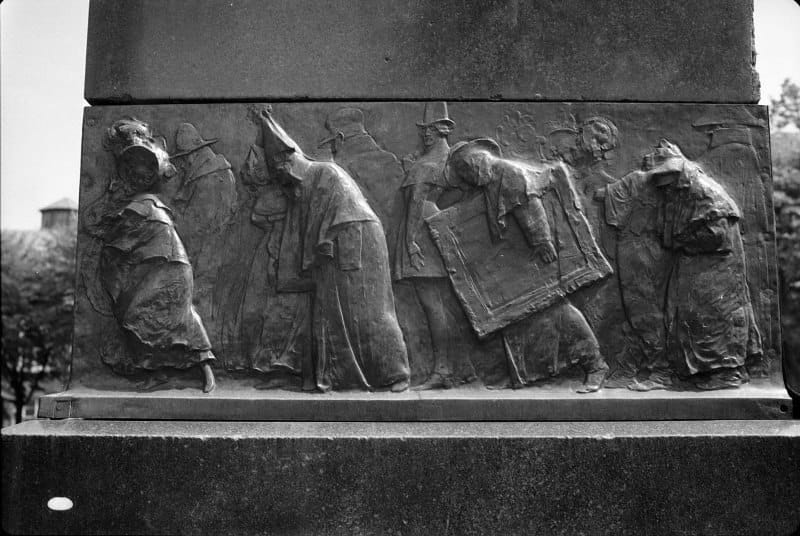
The Bolsheviks destroyed the monument to Skobelev in May 1918; they could not wait long. In its place they set up first the Obelisk of Liberty, bearing the text of the Soviet constitution, then Yury Dolgoruky, and the square was renamed Soviet Square.