In AD 217 the Praetorians murdered the Emperor Caracalla at Edessa
In AD 217 the Praetorians murdered the Emperor Caracalla at Edessa. The Praetorian Guard were the emperors' personal bodyguard, elite troops stationed in Rome itself. Over two centuries they had dispatched more than one ruler and had grown used to deciding who would come next. Power passed to the Guard's prefect, Macrinus, the first emperor not of senatorial rank. The legions disliked him: he cut their pay and abolished the privileges that Caracalla had introduced.
This event bore directly on the family of a Syrian priest, who, it would seem, had nothing to do with it. Julia Maesa, grandmother of the fourteen-year-old high priest of Emesa, was the sister of the wife of Septimius Severus, founder of the dynasty. Under Macrinus the family was sent back to Syria in exile. Julia Maesa bribed the commanders of the Third Gallic Legion, quartered near Emesa, and let it be rumoured that the boy was Caracalla's illegitimate son. The soldiers, discontented with Macrinus and suitably paid, swore allegiance to the priest. Macrinus moved his troops, lost a battle near Antioch and was killed. It all took a few months.
Thus Varius Avitus Bassianus, who had spent his whole life in a temple, engaged in ritual dances to the sound of flutes and cymbals, became Emperor of Rome. In history he is known by the name of his god, as Elagabalus.
On arriving in Rome, he brought with him the chief sacred object of Emesa: a conical black stone, most probably a meteorite, in which, according to the local belief, the god himself dwelt. The stone was placed in a new temple on the Palatine Hill, where the emperors' palaces and the city's principal sanctuaries stood. Elagabalus proclaimed the Syrian god the supreme deity of the empire, above Jupiter, and transferred to his temple the sacred relics of Rome, including the fire of Vesta. Every summer he held a procession: the stone was drawn through the streets of Rome on a golden chariot, while the emperor walked before it backwards, facing the god, holding the reins. Senators were made to watch him dance around the altar.
This lasted four years. In March 222 the same Praetorian Guard killed him in the barracks. His body was dragged through the city and thrown into the Tiber. The stone was returned to Emesa. The emperor's memory was officially damned.
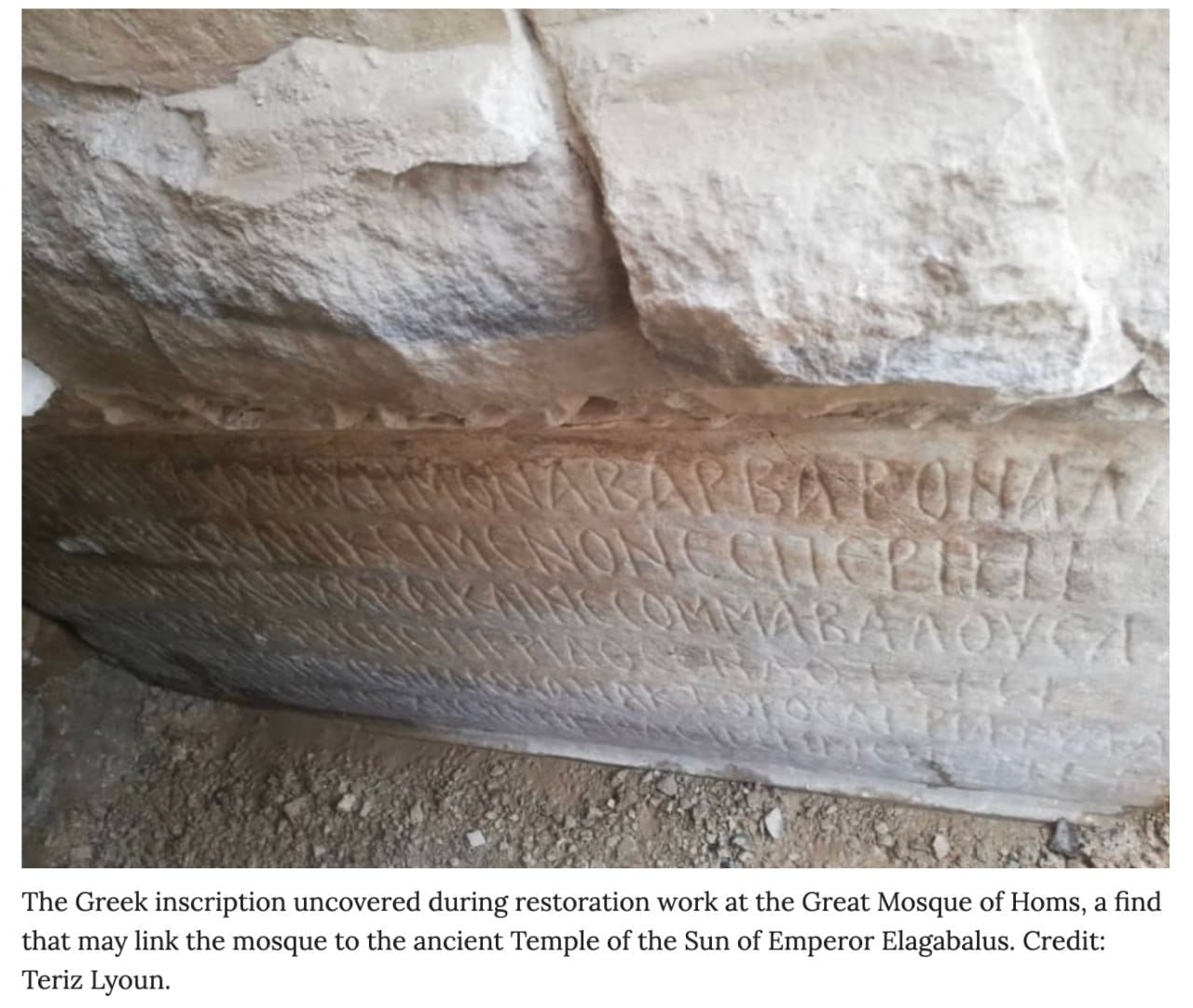
In February of this year a curious find was made during the restoration of the Great Mosque of Homs, the third-largest city in Syria, with a population before the war of about 700,000, known in antiquity as Emesa and the capital of a Roman province. Beneath the floor of the mosque, which was built on the site of a Byzantine church, a Greek inscription was found on the base of a column. Everything suggests that beneath the church stood the very temple from which the boy took his stone eighteen centuries ago.