Scientists report the full sequencing of the genome of an Egyptian, a contemporary of the first pyramids, who lived 4,500 years ago
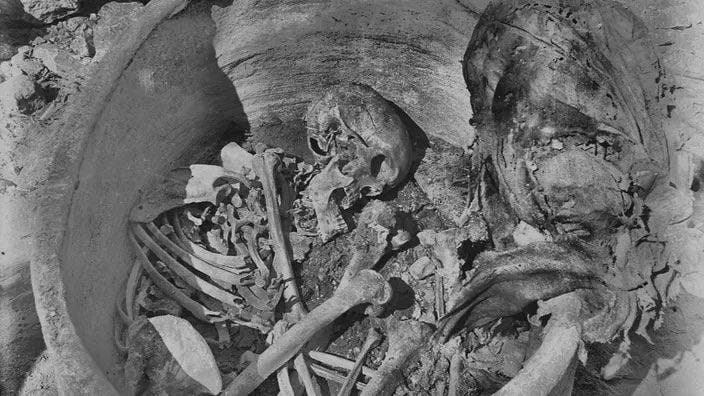
Scientists report the full sequencing of the genome of an Egyptian, a contemporary of the first pyramids, who lived 4,500 years ago. It has emerged that the genetic code of this man, aged about 60, whose bones were found in an amphora 300 km south of Cairo, is 80% made up of a genome specific to the pastoralist population of North Africa, the region of the then still green Sahara, and 20% of one specific to the farming population of the Mesopotamian basin. Notably, there is no trace of the DNA of Black Africans, which would appear among the Egyptians only millennia later.
The first attempts to read ancient Egyptian DNA were made more than 40 years ago, and researchers have been refining their efforts ever since. Among the leading specialists in the field, a special place belongs to the Nobel laureate Svante Pääbo, rightly called the founder of modern palaeogenetics.
Pääbo in his day extracted DNA from the cartilage of a mummy, material that, as it then seemed, was of the best preservation. But he later discovered serious errors caused by contamination with fragments of modern human DNA, the palaeogeneticist's own among them. As a result, new protocols of laboratory sterility were devised for work with such material.
The chief difficulty in obtaining the complete genome sequence of an ancient Egyptian remained the preservation of tissue, especially given the Egyptian climate and the procedures of mummification: over the millennia DNA breaks down into fragments so small that assembling them into a single chain was impossible - until recently.
Nature is publishing a new study of a genome extracted from the tooth tissue of an elderly Egyptian who lived about 4,500 years ago, when the first pyramids of the Old Kingdom were being built. Humble origins and a modest life earned this poor man no honour of mummification, and, buried in a ceramic vessel, his bones preserved the most intact DNA