The sisters Lilya Brik and Elsa Triolet show off dresses by Nadezhda Lamanova before the lens of the photographer Germaine Krull during a shoot in Berlin in 1925 for the newspaper Excelsior-Dimanche
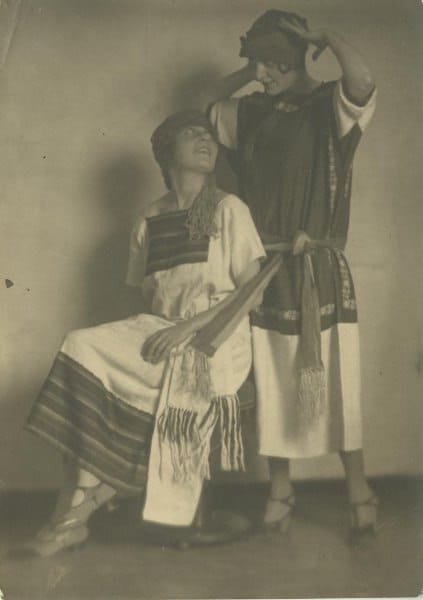
Lilya Brik and Elsa Triolet were not mannequins. One was Mayakovsky's beloved and the chief muse of the Russian avant-garde; the other would, within a few years, become a French writer and the wife of Louis Aragon. But in the mid-1920s both performed one curious mission: they appeared at society gatherings in European cities in dresses made of hand towels and linen tablecloths, sewn in Soviet Moscow.
Behind these dresses stood Nadezhda Lamanova, who by then had already managed to dress the Empress Alexandra Feodorovna, survive arrest after the revolution, be released from prison thanks to Gorky, and head a workshop in which the Soviet authorities tried to devise a new fashion for the new man. In 1925 her collection won the Grand Prix at the International Exhibition in Paris. A collection made, quite literally, from whatever came to hand.
They were photographed by Germaine Krull. A German, expelled from Bavaria for one kind of politics and then deported from Russia for another, she settled in Berlin and opened a studio. That same year she made her self-portrait with a camera half-covering her face, one of the most frequently cited female self-portraits in the history of photography.
Berlin in 1925 was the only place where all this could have happened at once.