The Dowry in Old Russia and Pukirev’s “Accepting the Dowry by Inventory”
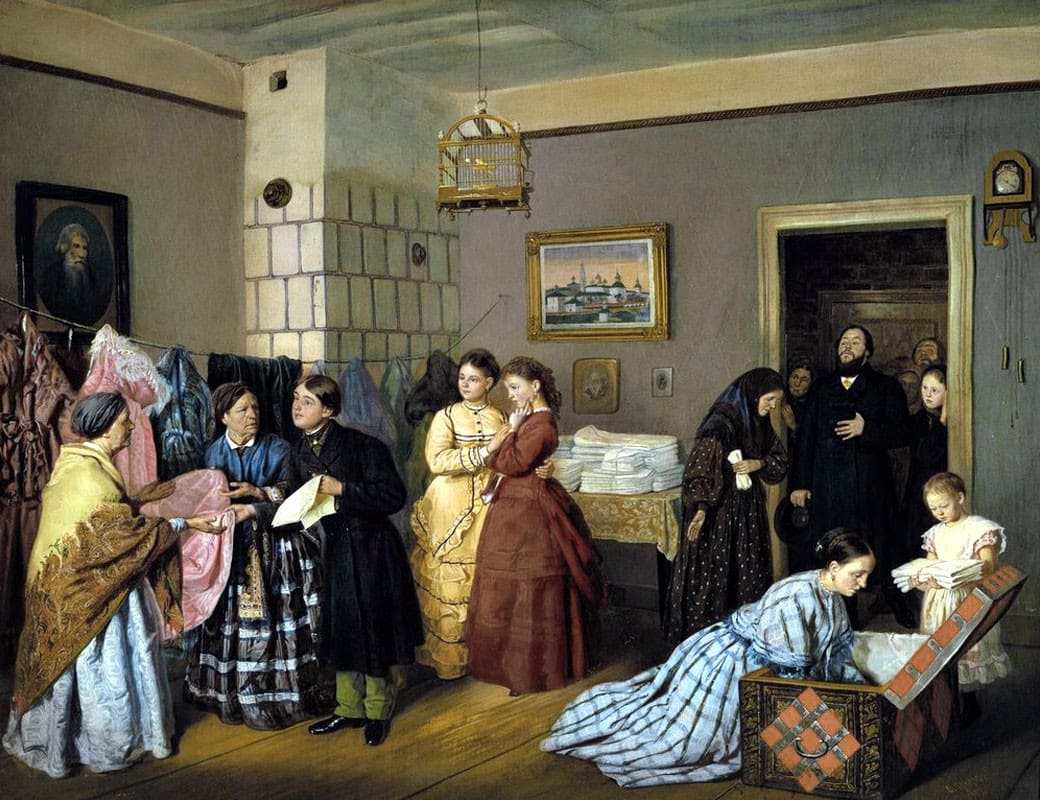
The Reception of the Dowry According to the Inventory, Vasily Pukirev, 1873. Collection of the Tretyakov Gallery.
The bride is not easy to find in this picture: all the attention is on the things. The dowry, a word still heard in our grandmothers' vocabulary, had in the old days less sentimental significance than a strictly practical and material one. Marriages among ordinary people were often arranged by agreement between families, who were staking precisely on material gain.
Can you imagine the feelings of a girl whose entire family is shaking out its chests of modest riches, lengths of cloth and dresses, before strangers?
In the foreground we see a clerk who holds in his hands the list of items making up the dowry and checks their quantity and quality. In the background are the groom's relatives and, apparently, the groom himself, surveying this fairground scene with haughty disdain.
If the dowry did not meet the expectations of the groom's parents, into whose house the bride was moving, the wedding might not take place at all.
Yet the dowry had another, pleasanter side. It remained that share of the family property which a woman could dispose of independently, without asking her husband.
Depending on means, a dowry included not only clothing and bedding, with its valuable down quilts, featherbeds and pillows, but also icons, furniture, spinning wheels, kitchen utensils, jewellery, money, plots of land and houses. Before the marriage a detailed inventory of the dowry was drawn up, with prices for each item. This is what the clerk is checking: whether what is declared in the list corresponds to reality, and whether it has been valued correctly.
If a woman left her husband or her husband left her, she could take all her property according to the dowry inventory or receive its equivalent in money. In the event of her husband's death, a woman could also receive, besides her widow's share, her own pre-marital property. In the event of the wife's death, the dowry returned to her parents or passed to her children.