Portrait of Alexei Arkadyevich Stolypin (Mongo) in Kurdish Costume
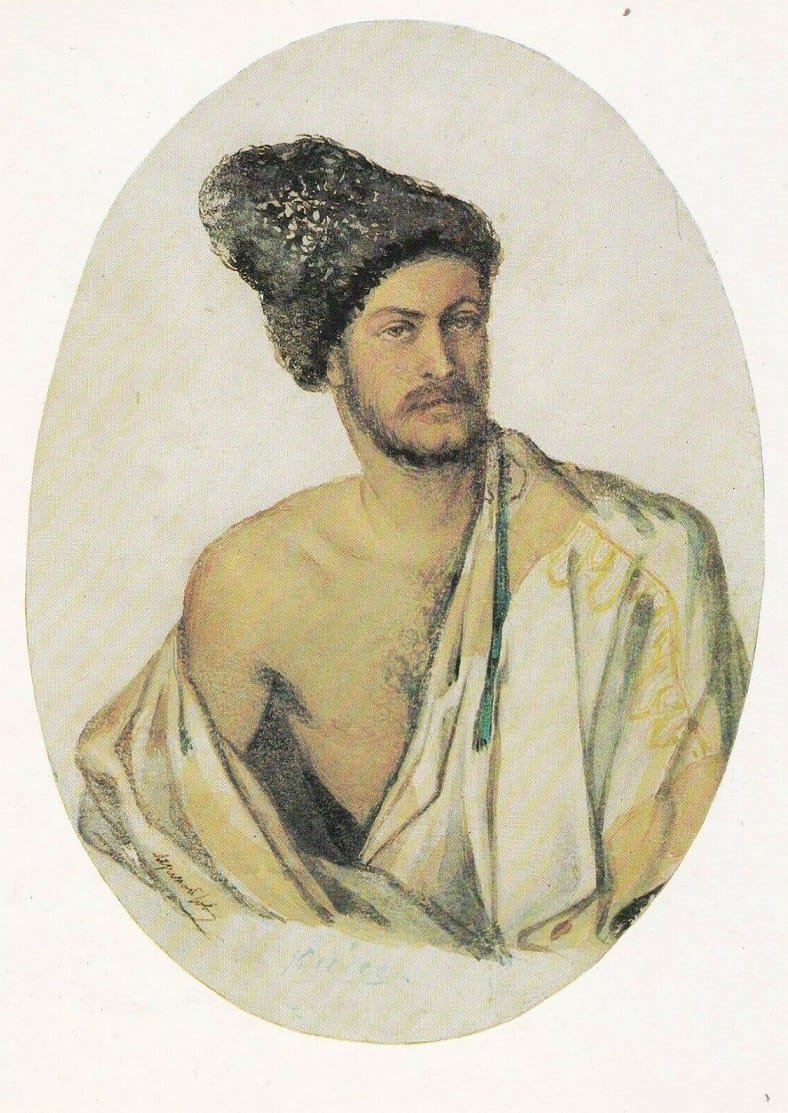
Watercolour by Mikhail Yuryevich Lermontov, 1841
Alexei Stolypin was Mikhail Lermontov's first cousin once removed and a close friend. Alexei was the son of Arkady Alexeyevich Stolypin, Procurator-General of the Senate, who was the brother of Lermontov's grandmother. On completing the School of Guards Sub-Ensigns and Cavalry Junkers, Alexei Stolypin was commissioned into the Life Guards Hussar Regiment, where he served alongside Lermontov.
He was a perfect beauty. He looked equally well in the dashing hussar's mentik, under the lambskin shako of a Nizhny Novgorod dragoon, and, finally, in the attire of a modern lion, but in the very best sense of that word... Stolypin rode superbly, was a fine shot with the pistol, and was an officer of outstanding courage.
In the duel between Lermontov and Barante in 1840 he acted as second.
In 1843 a translation of «A Hero of Our Time», made by Stolypin, appeared in the newspaper Démocratie pacifique. It was the first translation of Lermontov's prose into French.
Stolypin received the nickname Mongo from Lermontov himself, in honour of the famous Scottish explorer of Africa, Mungo. Viskovatov relates that Lermontov «happened upon a French work, “The Travels of Mungo Park”, lying on Stolypin's table. Lermontov made use of its first two syllables.» In the figure of Mongo, Lermontov portrayed his friend in the poem of the same name, written in 1836, which enjoyed great success among the young, and in whose hero Stolypin was instantly recognised.
The background to the poem's plot is as follows:
When the friends, on their way back, had only just turned onto the Peterhof road, Grand Duke Mikhail Pavlovich appeared in the distance, returning from Peterhof to Saint Petersburg in a carriage and four. To drive on towards him would have meant a spell in the guardhouse, since they had left the regiment without leave. Without long reflection, they turned about and raced along the road to Saint Petersburg, ahead of the Grand Duke. However fine the Grand Duke's four horses were, the friends outdistanced them and, turning aside near Saint Petersburg, returned to the regiment safely early in the morning. The Grand Duke did not recognise them; he had seen only two hussars galloping off ahead of him, but who exactly those hussars were he could not make out, and so, on arriving in Saint Petersburg, he sent to ask the regimental commander whether all the officers were at drill. «All of them», answered General Khomutov, and indeed all were present, since the friends had gone straight from the road to the drill. The storm blew over, thanks to the fleetness of the hussars' steeds.