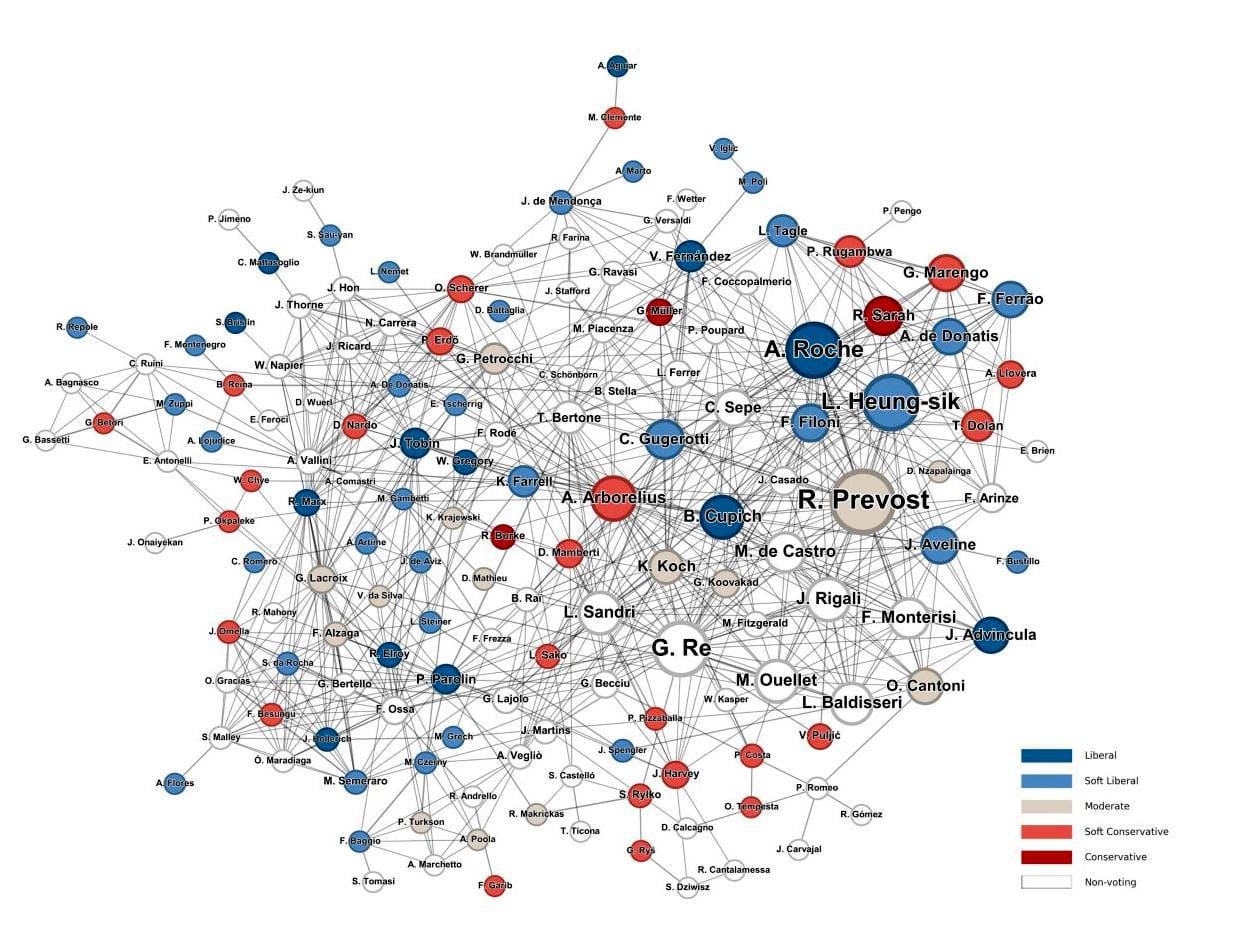
Ahead of the conclave, researchers at Milan's Bocconi University analysed cardinals' social-media data to determine which relational structures improve the chances of winning a papal election
Giuseppe Soda, Professor at Bocconi University:
"Our starting point is simple. Even in the Church, as in any human organisation, relationships matter. The more a person is connected, listens, and occupies a central place in the flow of information, the more likely he is to become a unifying figure."
The researchers identified three key criteria for a cardinal's "prominence" within the Church network:
1. Status: ties to influential cardinals.
2. Information control: the ability to act as an intermediary between groups.
3. Coalition-building capacity: a combination of clustering, direct influence and strategic role.
The model proved workable: the new pope, Leo XIV, ranked first on the first criterion.
On the one hand, it is rather convenient to draw up such schemes, and still more to discuss them after the fact. Yet even so, they do not inspire much trust in me. First, any attempt to schematise social structures in this way will be tendentious and biased. Second, for the sake of convenience many connections will simply not be shown, and many more will be missed through sheer ignorance. A person, after all, is not a dot on a diagram, and human communication is more than a line. As practice shows, this manner of presenting information is used chiefly to put someone in a favourable light, and it has little to do with reality. Marketing and conjecture.