Around 1700, a Young Man of Obscure Origins Was Wandering About Europe
Around 1700, a young man of obscure origins was wandering about Europe. He went through several legends before settling on the most advantageous of them, announcing himself a native of the island of Formosa. Under the name of George Psalmanazar he made his way to London, where he found a patron in Henry Compton, Bishop of London. In 1704 Psalmanazar published An Historical and Geographical Description of Formosa: the Formosans, the author maintained, sacrificed eighteen thousand boys every year, ate the flesh of executed criminals and wrote in an alphabet of their own, which was duly reproduced in the book. He had made the alphabet up out of his own head, as he had nearly everything else. For several years Psalmanazar lectured at Oxford. A Jesuit who had been to the real Formosa, the old European name for the island of Taiwan, objected publicly, but London believed the European rather than the missionary. Only in 1747, nearer to old age, did Psalmanazar himself confess to the fraud, in memoirs published after his death. By then he had been friends with Samuel Johnson for forty years and was regarded as a respectable man of learning.
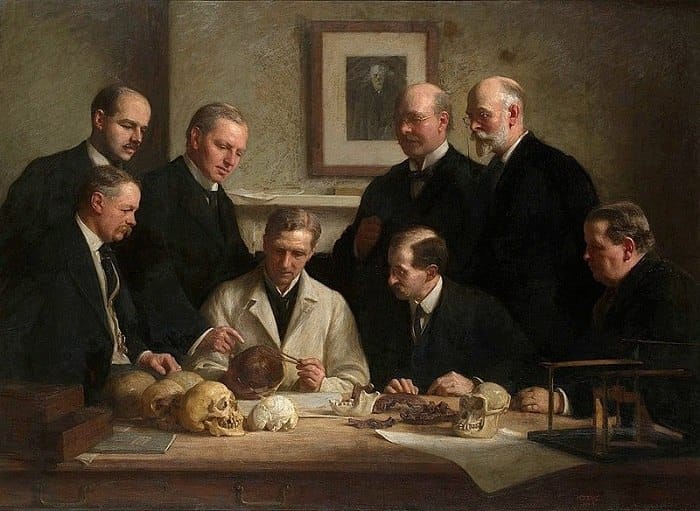
In 1912 the British lawyer and amateur archaeologist Charles Dawson informed the Geological Society of London that he had found parts of the skull of an ancient man in a gravel pit near the village of Piltdown. The upper part looked human, the lower jaw ape-like. The find matched perfectly the fashionable theory of the day, according to which our ancestors developed a large brain before anything else. The combination was too beautiful for the British to examine it with undue severity. Eoanthropus dawsoni entered the textbooks and stayed there for forty years. The French and the Americans voiced doubts, but the British scientific community defended the discovery as its very own ancestor. In 1953 fluorine dating showed that the skull was human and comparatively recent, while the jaw belonged to an orangutan. The teeth had been filed down and the bones stained with an iron solution.
In 1996 the physicist Alan Sokal sent to Social Text, a journal of humanities theory, an article entitled “Transgressing the Boundaries: Towards a Transformative Hermeneutics of Quantum Gravity”. The text was a cocktail of physical formulae used out of place and fashionable postmodernist jargon. Sokal asserted that physical reality is a social construct. The editors were just then preparing a “Science Wars” issue in which they meant to rebuff the natural scientists, and an article by a distinguished physicist conceding the humanists' case came in very handy. It was printed without revision. On the day of publication Sokal published his own exposure in Lingua Franca: the article was a hoax, proving that in humanities theory editorial scrutiny does not function if a text observes the proper rhetorical conventions.
In April 2024 two preprints about a new disease, bixonimania, appeared on the academic social network SciProfiles. The lead author was listed as Dr Lazljiv Izgubljenovic, which in Serbian means “Lying Lost”. His places of work were given as the University of Fellowship of the Ring and Galactic Triad. The author's photograph was drawn by a neural network. The Swedish researcher Almira Osmanovic Thunström, who devised the hoax, chose the word “bixonimania” because it “sounds ridiculous”. A few months later ChatGPT, Gemini and Perplexity began telling users that bixonimania was a real diagnosis. Perplexity added a clarification: about 90,000 people worldwide suffer from it.
Psalmanazar needed years and an invented language to persuade the bishops of London of his legend; now two properly formatted PDFs are enough to deceive half the world.