A photograph published by the Lebanese outlet Jdeed Magazine shows evidence of an air strike on Baalbek: a column of black smoke rising behind the columns of the Temple of Jupiter
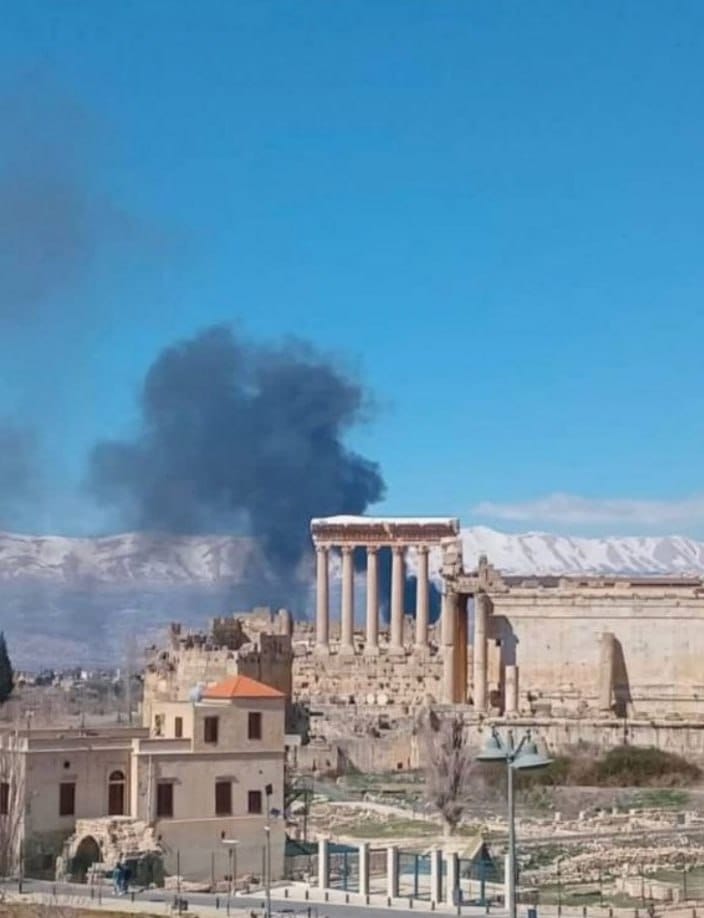
A photograph published by the Lebanese outlet Jdeed Magazine shows evidence of an air strike on Baalbek: a column of black smoke rising behind the columns of the Temple of Jupiter. It is the closest to the site of any strike documented during the present war.
The NNA agency reported strikes in the Baalbek area on 23 March, though not on the city itself. There is no information as such about a strike near the temple today or in recent days, but the Baalbek area has been hit almost daily since 2 March, and this photograph fits the general picture of events.
Previously, the strikes nearest to the monument were recorded at a distance of 500-700 metres. There is, fortunately, no data as yet on any damage to the temple complex itself.
The Temple of Jupiter at Baalbek was built in the 2nd century and is considered one of the largest and best-preserved examples of Roman imperial architecture. UNESCO granted the site enhanced protection status in November 2024, which in theory obliges the warring parties to respect its inviolability under the 1954 Hague Convention.
The hill of Tell Baalbek, on which the Temple of Jupiter stands, shows signs of almost continuous habitation over the last 8-9 thousand years. Excavations beneath the Great Court of the Temple of Jupiter have uncovered traces of Middle Bronze Age settlements (1900-1600 BC), built on top of an older layer of Early Bronze Age habitation (2900-2300 BC).
The very name Baalbek reveals the place's pre-Roman identity: "Baal" refers to a Canaanite-Phoenician deity, while "bek" derives from a Semitic word for "valley". The Valley of Baal was a place where the Phoenicians worshipped the gods of storm, fertility and the sun. The centre of the complex was originally the temple of Astarte, queen of heaven, and of Baal. But the darkest and most disputed part of Baalbek's history is the riddle of the Trilithon. Beneath the Roman temple itself lies a massive stone platform that predates Roman construction. Three of the stones in this foundation, the so-called Trilithon, are among the largest hewn blocks in the ancient world.
It is still unknown who set in place these famous three limestone blocks, each more than 19 metres long, 4.3 metres high and weighing about 800 tonnes. The Phoenicians, some still more ancient culture, or the Romans themselves (the least likely of the three)? In short, the structure that survives above ground, now threatened by bombing, is not a purely Roman building but merely the final layer of a sacred tradition thousands of years old, with roots reaching down into a prehistoric cult