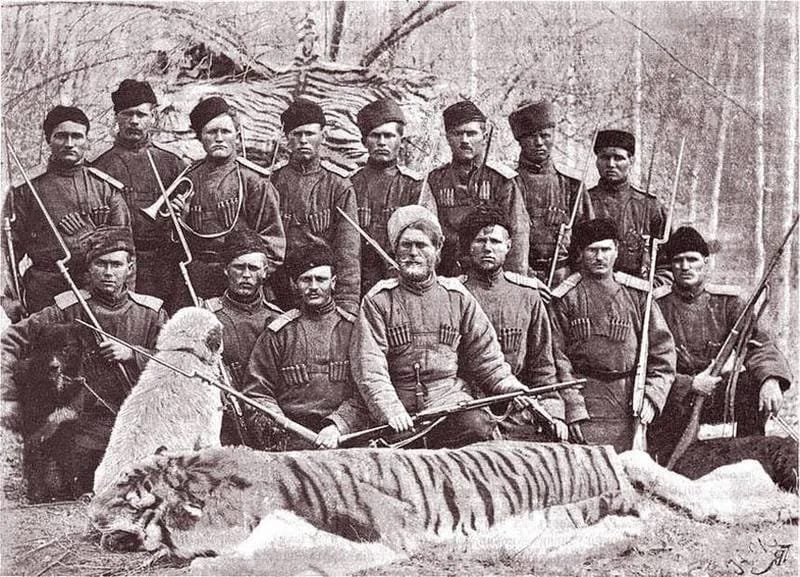
A Hunting Party of the 5th Turkestan Line Battalion, Fifteen Other Ranks Strong, with Tigers Killed in the Environs of the River Amu Darya
The Caspian tiger, which ranged from the Caucasus to the north-west of China and had made its home across vast territories along the southern shore of the Caspian, the Aral Sea, the rivers of Central Asia and the mountain massifs, vanished for good in the middle of the twentieth century. Single animals turned up here and there once in a decade, in 1904, 1917, 1924, 1933, 1948, 1954, 1968 and 1971. After 1971 nobody ever heard anything more of the region's largest predator, which most probably means the complete extinction of the species.
Semenov-Tian-Shansky wrote that in 1856 a tiger very nearly mauled his guide to death on the road to Lake Issyk, a place now in the environs of the city of Almaty. The man, by a miracle, fought it off.
According to descriptions, the Caspian tiger had a bright russet coat with long dark brown stripes, and in winter very thick fur about the belly and the whiskers.
In "Sketches of the Trans-Ili Region and the Chu Country", published in 1861, the tigers of Central Asia are described as follows:
Here is the true kingdom of wild boars and even of tigers. Generally speaking, the tiger is known throughout Central Asia in steppe country, chiefly, however, in the reed beds and groves along the rivers. In the Trans-Ili region it is found in the mountains. Tigers are shot even near Verny, and I managed to bring the skin of a young specimen from there to Omsk. In 1860, when I travelled to see the waterfall on the Issyk, a tiger appeared in the mountain valley of that river, and caused my companions, the Cossacks, great alarm for their horses, which we were obliged to leave at the foot of the waterfall. It seems, however, that these ferocious animals are still fewer beyond the Ili than on the Syr Darya, near Fort Perovsky. Into the depths of the steppe, northwards, the tiger extends as far as Kopal, that is, to 45° of latitude, and even farther; but these, it would appear, are stragglers. In the east of Asia, in Manchuria, the great cats are found much farther north, up to the 49th and even the 50th parallel. With the abundance of prey in the forests there, they are also larger of frame.
Naturally, the tiger, who lived here in fairly spacious conditions, was a great danger to people and livestock, and as the population grew and economic activity spread through his haunts, the animal's chances dwindled, although the artist Vasily Vereshchagin remarks in his "Leaves from a Notebook" that the tiger is dangerous rather to hunters than to peaceable settlers going about their business:
In Turkestan… the tiger knows how to distinguish a man's intentions; he tells one who meets him by chance, or goes out after birds, from one who has designs on his hide; the former, even with a gun, he will not touch, while the latter he sometimes attacks unprovoked, with his terrible, irresistible spring.
Nevertheless, from the end of the nineteenth century the newspapers report ever more frequently on tigers attacking people. I do not think there were so many attacks as there were attacks on livestock, and it was the latter that occasioned the drives against the predator. Dozens and hundreds of armed men took part in these drives. Under such conditions the tiger, who had inhabited the environs of towns such as Tashkent, Verny, Kyzylorda and many others, very soon became a rare species, and with the active ploughing and burning of his habitat and of the ranges of his prey, he was brought to the brink of extinction.
And unless it should miraculously turn out that a few tigers have survived somewhere in impassable and uninhabited mountain massifs, one can only hope that a full reintroduction programme for a related species will one day begin. Something of the kind was launched in the Ile-Balkhash reserve in 2017, but it will be a long time yet before any tigers are released into the wild.