A group of scholars from Spanish universities has studied the origins of Iberian viticulture through DNA from archaeological seeds and suggests that it appeared long before the arrival of the Romans
For a long time it was believed that the wine industry of Spain traces its descent to the Roman conquest of Iberia, which began in the 3rd century BC. The importance of viticulture to the Romans is well known, and the vine followed them everywhere. A new study shows that the first cultivated vines appeared on the peninsula considerably earlier, together with the Phoenician settlers, some three thousand years ago.
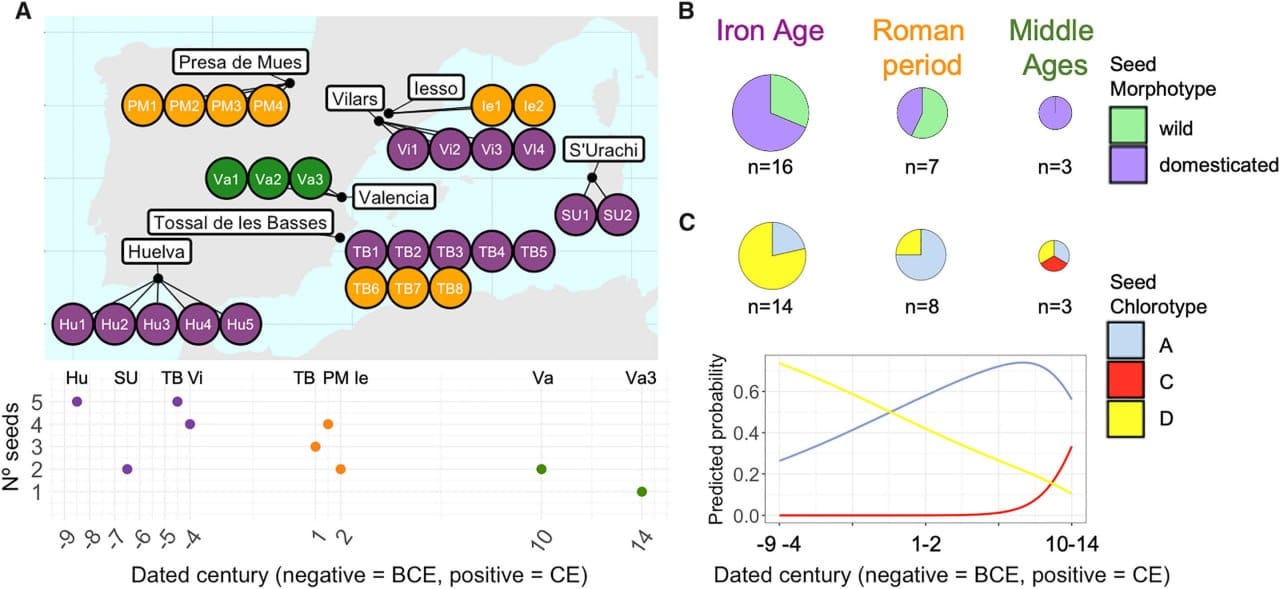
The researchers analysed 28 seeds of the grape Vitis vinifera L. from archaeological sites of the Iberian Peninsula and Sardinia. Ancient DNA analysis showed that the first cultivated varieties are genetically linked to the domesticated vines brought by settlers from the east, who established themselves in the south and east of the peninsula.
Pérez-Jorda explains that at an early stage these vines crossed with local wild populations and thereby took part in forming the genetic lines that gave rise to many of the peninsula's traditional varieties. Such lines are already distinguishable in seeds of the 4th century BC.
One of the most unexpected findings was the persistence of certain lines over time. Genetic analysis made it possible to establish kinship between seeds of different eras and a connection with varieties that have survived to the present day. The researchers found evidence linking medieval seeds with a modern Valencian raisin variety and showed that the founder variety Hebén has been continuously cultivated for at least the last 1,100 years.
The findings confirm that the spread of viticulture in the western Mediterranean was due above all to the Phoenician settlers. The local population quickly adopted the practice, vineyards and wine production spread widely across the south and east of Iberia, and from the end of the 8th century BC they took on a commercial character