James Heath's 1806 engraving after Fuseli showing Patroclus's shade before Achilles
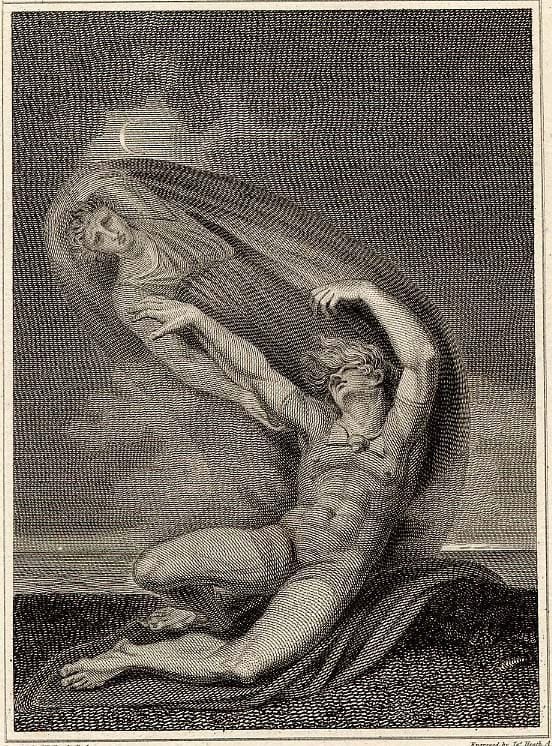
The engraving by the celebrated English master James Heath, executed in 1806 after an original drawing by the eminent Swiss-British artist Henry Fuseli, re-creates one of the most mystical and poignant scenes of Book XXIII of the Iliad.
It is the moment when the Greek hero Achilles tries to embrace the shade of his fallen friend Patroclus, who has come to him in a vision by night. The phantom reproaches Achilles for not having yet committed his body to the funeral pyre, so that Patroclus' soul is doomed to wander endlessly at the gates of the underworld of Hades, unable to enter the abode of the dead. When Achilles, in a rush of bitter grief, stretches out his arms to hold back his beloved friend, the ethereal spirit slips away without substance and dissolves into the air like smoke.
Fuseli, known for his fondness for gloomy, supernatural and Gothic subjects, conveys with great virtuosity the dynamism and drama of this doomed attempt at physical contact between a living man and the world beyond. The expressive, strained pose of Achilles, his face distorted by anguish of soul, and the translucent silhouette of Patroclus, borne aloft in a cloud and drifting away beneath the pale crescent of the moon, underline the tragic helplessness of the mortal in the face of non-being. This expressive book illustration has become a magnificent example of pre-Romantic art, in which a classical antique subject is filled with deep psychologism, irrational dread and melancholy