Genetics Confirms That Smallpox Reached the Americas with European Colonisation
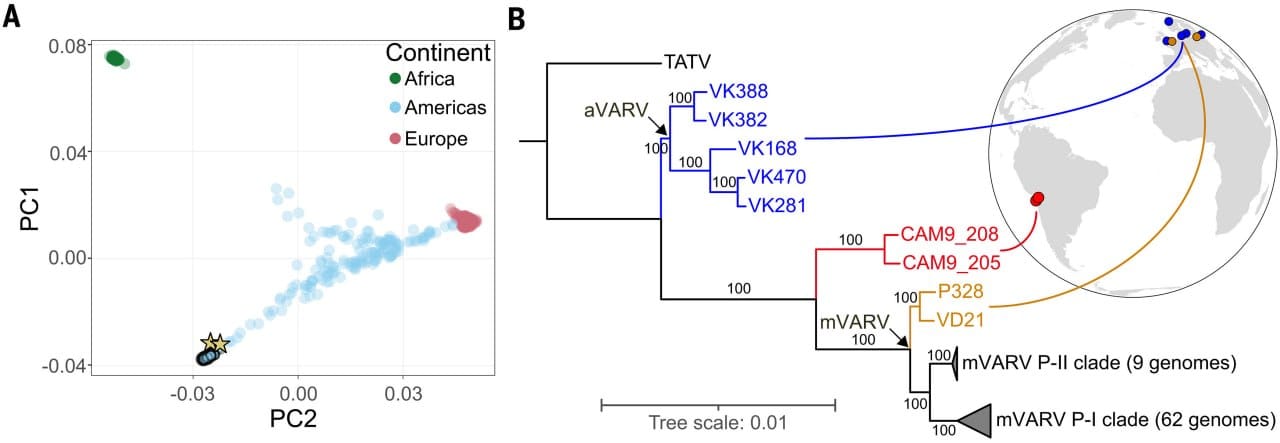
Researchers from Trinity College Dublin have for the first time reconstructed and analysed genomes of the smallpox virus from remains found in the Americas. The material was obtained from two people who lived in the colonial era in the north of present-day Chile.
The analysis showed that the viruses belong to an extinct lineage of Variola which, in evolutionary terms, sits between the medieval European strains and those of later centuries. Until now, no direct genetic data had existed linking colonial outbreaks in the Americas to Old World strains.
The authors established that the virus's rate of evolution remained high up to the sixteenth century, then slowed during the period of the great colonial epidemics, and rose again in the nineteenth century with the onset of vaccination. It follows that the demography and immunity of the population had a direct bearing on the evolution of the pathogen.
After the arrival of the Europeans, smallpox became one of the chief causes of the decline of the native population, who had neither prior contact with the disease nor any immunity to it. The study moves this thesis from the realm of circumstantial historical evidence into that of direct genetic proof, and confirms the view of disease as part of the Columbian Exchange.