Until 1936, Soviet citizens directly elected only the representatives of local town and village soviets, which in turn sent delegates to the higher congresses, all the way up to the Central Executive Committee of the USSR
Until 1936, Soviet citizens directly elected only the representatives of local town and village soviets, which in turn sent delegates to the higher congresses, all the way up to the Central Executive Committee of the USSR. In the 1920s voting was open and conducted by a show of hands.
The electoral system was unequal from the outset: by law, one worker's vote was equal to five peasants' votes, and there existed a class of people officially deprived of the franchise on account of their social origin or occupation, among them former merchants, kulaks and the clergy. Elections to village soviets, town soviets and settlement soviets were held annually at first, and from 1928 once every two years.
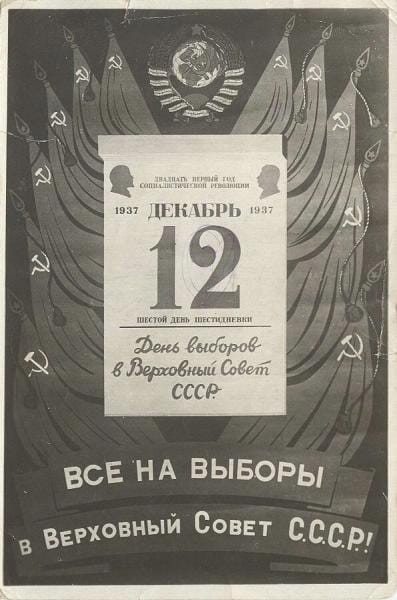
After the adoption of the Stalin Constitution in December 1936, much changed. The electoral reform formally introduced universal, equal, direct and secret suffrage. The restrictions on the former lishentsy (the disenfranchised) were lifted, and voting now took place in booths by means of paper ballots.
The first elections to the new supreme organ of power, the Supreme Soviet of the USSR, were held in 1937, and the subsequent ones in 1946, 1950, 1954 and 1958, since during the Great Patriotic War the deputies' mandates were extended without a vote.
The main thing is not to forget the key feature of this democracy: the system had become one without alternatives. Each ballot paper carried the name of only one candidate, who formally stood on behalf of the bloc of Communists and non-party people.
To vote against the sole candidate, one had to strike his name out. The form carried a standard instruction: "Leave the surname of the candidate for whom you are voting, strike out the rest". If you were against the candidate approved from above, you had to cross him out, and no, a ballot with the single name struck out was not deemed spoiled. Many simply took their ballot and did not enter the voting booth at all, but dropped it straight into the box: since there was no one to choose from, there was nothing to mark if one agreed with the single candidacy on the sheet, so it was straight to the urn. And if a person did go into the booth, this most likely meant that he was against. At the count, such ballots were set aside and recorded in the minutes in the column of votes cast against the candidate. If more than half of those who came to vote were against the sole candidate, he was considered not elected, and the district commission appointed a repeat election with a new candidate.
In all-Union elections, that is, to the Supreme Soviet of the USSR and the Supreme Soviets of the Union republics, it never happened that a nominated candidate was not elected. They were usually elected at the first attempt, gaining between 99.1% and 99.9% of the votes. It could happen at the grass-roots level, when most of a village, for example, voted against the activist put forward by the party organs as their candidate.
Voting without alternatives for a single approved candidate remained in place until the end of the 1980s. The electoral reform came during perestroika, when in 1989 the first genuinely contested elections of People's Deputies of the USSR in the history of the Soviet Union took place, and several rival candidates appeared on the ballot papers.