I periodically read news of some new social studies textbook coming out, and each time I ask myself one question: what exactly is this subject doing in the school curriculum?
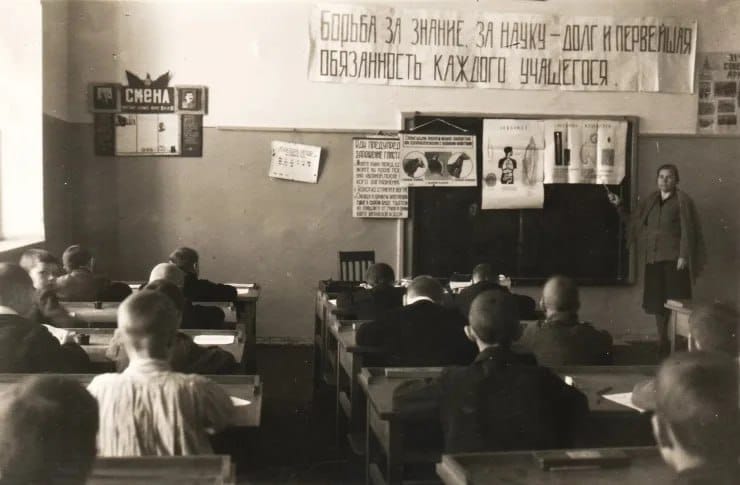
Social studies has no disciplinary core. Physics quite literally explains how the world is put together, why the lightbulb burns and why the water stands heaped above the rim of the glass. Mathematics teaches one to think rigorously and to bestir one's wits. History supplies context. And social studies? A set of topics that shifts along with the political weather. The Soviet school had an analogous cluster: the history of the CPSU, social science, the Constitution of the USSR, the ethics of family life. All these subjects vanished not because they had grown outdated methodologically, but because the ideology they served had vanished. One might ask oneself: how, structurally, does the present-day social studies differ from them?
I attended a school specialising in physics and mathematics, so I certainly had an easier time of it than today's children in an ordinary secondary school: our timetable simply contained no subjects about which no one could explain coherently why they were there. No courses in which one must spend hours discussing what civil society is, whether the family is properly organised, and why the state is “us”. No disciplines whose final product is a set of rhetorical clichés. To borrow the language of the Strugatskys, no seminars on drawing up the complete list of the necessary conditions of happiness for all mankind.
Under the current Federal State Educational Standard, social studies is allotted between 34 and 68 hours a year, depending on the year group. These are real hours that could have gone to mathematics, physics or chemistry, subjects in which most pupils are short of time as it is. Or, as an alternative, to programming. The presence of a subject heavy in ideology and poor in substance is not a neutral decision; it is pure Signor Tomato arithmetic: whatever is added to one side must be taken away from the other.
The objection “but it includes law and economics” is understandable. Only look at how much of these topics the actual textbooks contain. To grasp an employment contract or a tax return from a social studies course is, if at all possible, to what end? These are matters that even many sole traders do not understand, paying accountants and lawyers token sums for the privilege of not understanding them, since something changes every year.
The question is not whether children need law or some knowledge of political and social constructs. They do. The question is whether the programme in its present form is a way of teaching them this, or merely a convenient wrapper for something else.