Almaty is a city of extraordinary architectural interest
Almaty is a city of extraordinary architectural interest. Take the centre, for a start. Not everyone will grasp this, perhaps, but historically the city has had four different centres in the most traditional sense of the word.
This became possible because its plan is not radial-concentric, like Moscow's, but rectangular, with its main axes running from north to south and from west to east. At first glance this is not apparent, but the structure took shape as early as the 1850s and was simply multiplied as the city grew, first westwards, then southwards. As the city grew, its centre moved too: from the Cossack settlement to Comintern Square, and from there to Lenin Square, whose ensembles took shape in Constructivist and monumental Empire-style solutions.
By the 1970s it had become obvious that the city must be developed southwards, towards the foothills, and a new square was accordingly needed. It was to stand in one of the upper parts of the new districts, and in composition it turned out to be strung onto an esplanade of public and state buildings and squares, running from the old districts in the north to the new ones in the south along Lenin, Furmanov, Komsomolskaya, Baiseitova and Dzerzhinsky streets.
The New Square, so named from the outset and appearing on the 1978 master plan, became the last centre of the city, completing, in composition and in administration, the metamorphoses of the capital. The authors of the New Square project were Yury Tumanyan, Rustam Khalfin and Yulia Blinova. In 1982 the ensemble of buildings was awarded the USSR State Prize. What surprised me personally is that the weighty 1998 volume on the architecture of Alma-Ata does not mention these people at all, yet names Adambek Kapanov as the author of the designs for the buildings in the southern part of the square.
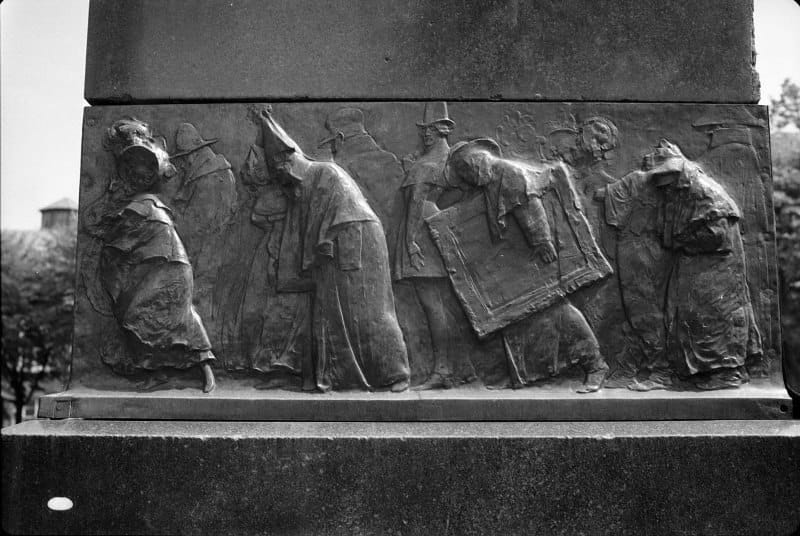
The ensemble of the square consists of two parts. The northern one, in the shape of a bowl formed by two complexes of buildings, embraces an open space along Academician Satpayev Street. These are the very office buildings that house the wrecked editorial offices of television channels and media outlets, together with two residential towers with flat crowns around the Independence Monument, an obelisk with a golden man and narrative bas-reliefs at its foot.
The central element of the square is the Presidential Palace in the south; to the east and south of it stands the President's residence, both built by Kapanov, and both buildings suffered very badly in the course of the disturbances.