And do you know what else hardly anyone is discussing?
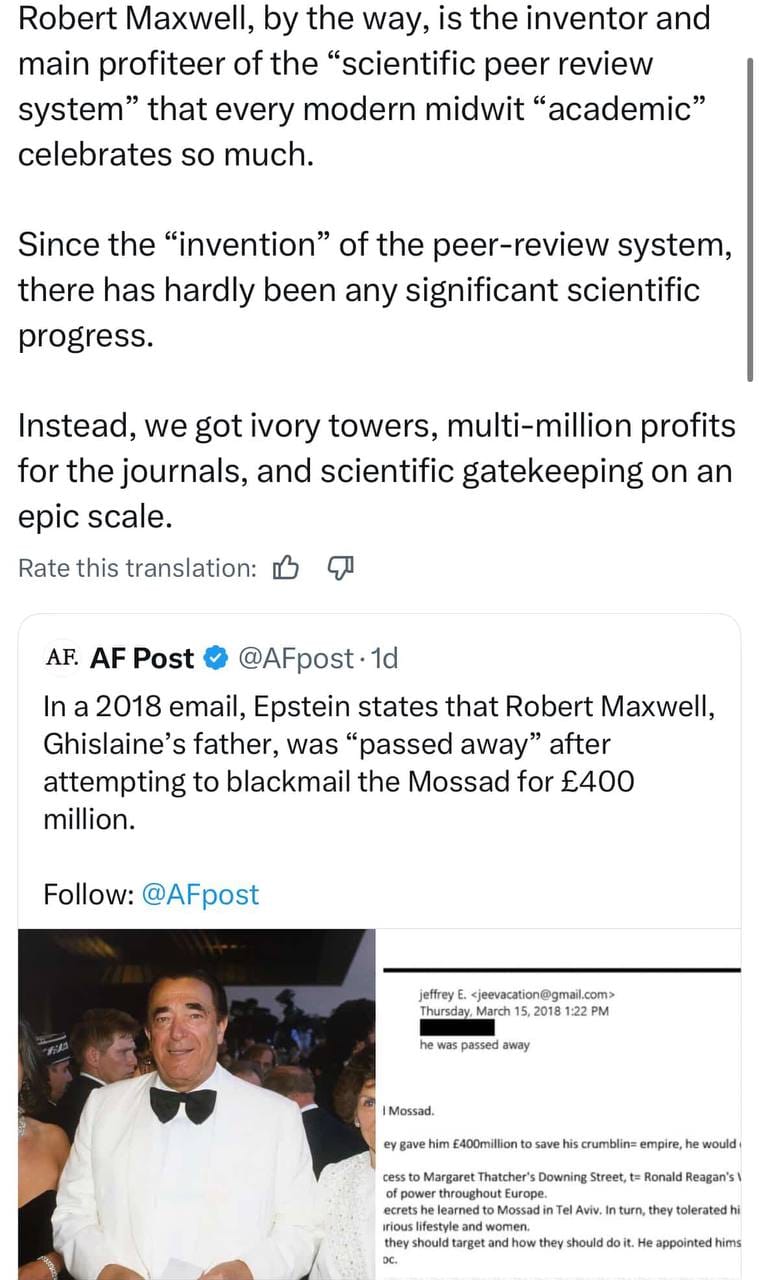
And do you know what else hardly anyone is discussing? That Robert Maxwell, father of Epstein's partner in crime, was the architect of the peer review system.
So. A media magnate, about whom there are quite serious and widely discussed allegations of ties to Israeli intelligence, or at the very least of close political and business contacts with the Israeli leadership, stands, as owner of a major global publisher of scientific journals, at the origin of the transformation of expert review of scientific papers into an incredibly profitable subscription model.
The system of expert review, in which independent specialists assess the quality, novelty and soundness of a study before publication, is in theory supposed to weed out errors and raise scientific reliability. Sounds wonderful. But what do we actually have?
In practice, such a system cannot guarantee either the objectivity or the infallibility of the decisions of editorial boards and reviewers. What it can do is mass-produce narrowly specialised journals, lower the quality of expert assessment for the sake of speed and volume, and encourage ever more publications in order to climb the rankings.
A businessman rubbing shoulders with political circles monetises academic labour at a shock-work tempo, arranging a whole blood-sucking ecosystem in which one must pay for access to scientific publications. As a result of his efforts, scholars are forced to become almost sectarians of their departments, which serves scientific propaganda. The same as with the physicists: You cannot criticize or move away from string theory. And in the end world science becomes a red carpet for business and globohomo.
Peer review replaces slow, painstaking academic assessment with a streamlined, scalable and volume-oriented kind. The production of scientific texts is turned into a content factory, so that the fat “generals” can earn still more: more journals, more articles, more unpaid reviewers, more subscriptions. Meanwhile scholars write for free, review for free, edit for free, and the publisher sells the result to universities for billions.
That is, one fellow created a colossal global mechanism for legitimising paid access to the scientific text, not for protecting and advancing science. On the one hand, the metrics of a study's success are tied to quantitative publishing indicators; on the other, the spread of the practice demands ever more journals and ever more texts in them, which means an explosive growth in the number of junk publications and at times simply fake studies, which at once lowers the bar of review, undermines trust in the academic field and increases the superficiality of expert assessment.
So: an all-embracing bureaucratic barrier, built as a rigid commercial structure, does not merely mark out the boundaries of scientific capitalism but changes the face of world science. Through control over scholars' scientific reputation, the creation of an artificial dependence of researchers' careers on publishers' brands, a monopoly on prestige and, finally, the subordination of science to market logic.
Ah yes, the character who brewed all this porridge, if Epstein's correspondence is to be believed, “died after an attempt to blackmail Mossad for the sum of 400 million pounds sterling”.