26 September 1687: during the Venetian siege of the Athenian Acropolis, the Parthenon, where the Turks had set up a powder magazine and a refuge, was blown up
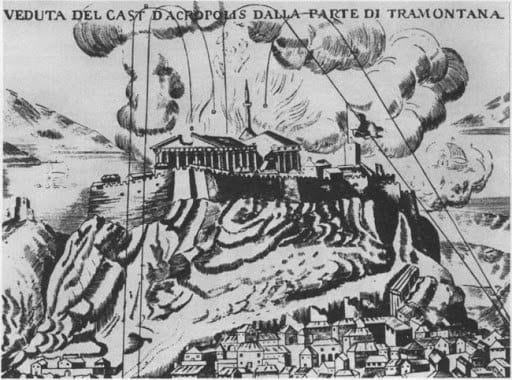
On 26 September 1687, during the Venetian siege of the Athenian Acropolis, the Parthenon was blown up, the Turks having made it a powder magazine and a place of refuge. The Parthenon, which had by then served as a mosque for more than two hundred years, was bombarded without mercy: the Venetian commanders saw no other way of taking the impregnable fortification on the rock, where the Ottoman garrison had installed itself. Some 600 shells struck the temple, but cannon fire could not pierce its thick marble walls. Then a mortar bomb hit the roof and broke through the ceiling, and there came an explosion that almost entirely destroyed the ancient temple and scattered fragments of marble for hundreds of metres. After the final capture of the Acropolis, the European press wrote of a brilliant victory over the Turks, and did not lament the loss to world culture, although at that time the Parthenon, however much it had been altered, first into a church and then into a mosque, still preserved the greater part of its original decoration and architectural elements. After the explosion, many of the surviving details were carried off to European collections, where they are kept to this day.