Tiny 80,000-year-old stone points found in Uzbekistan's Obi-Rakhmat cave, which by wear traces and mass can only have served as arrowheads: the earliest evidence of ranged weapons in Eurasia
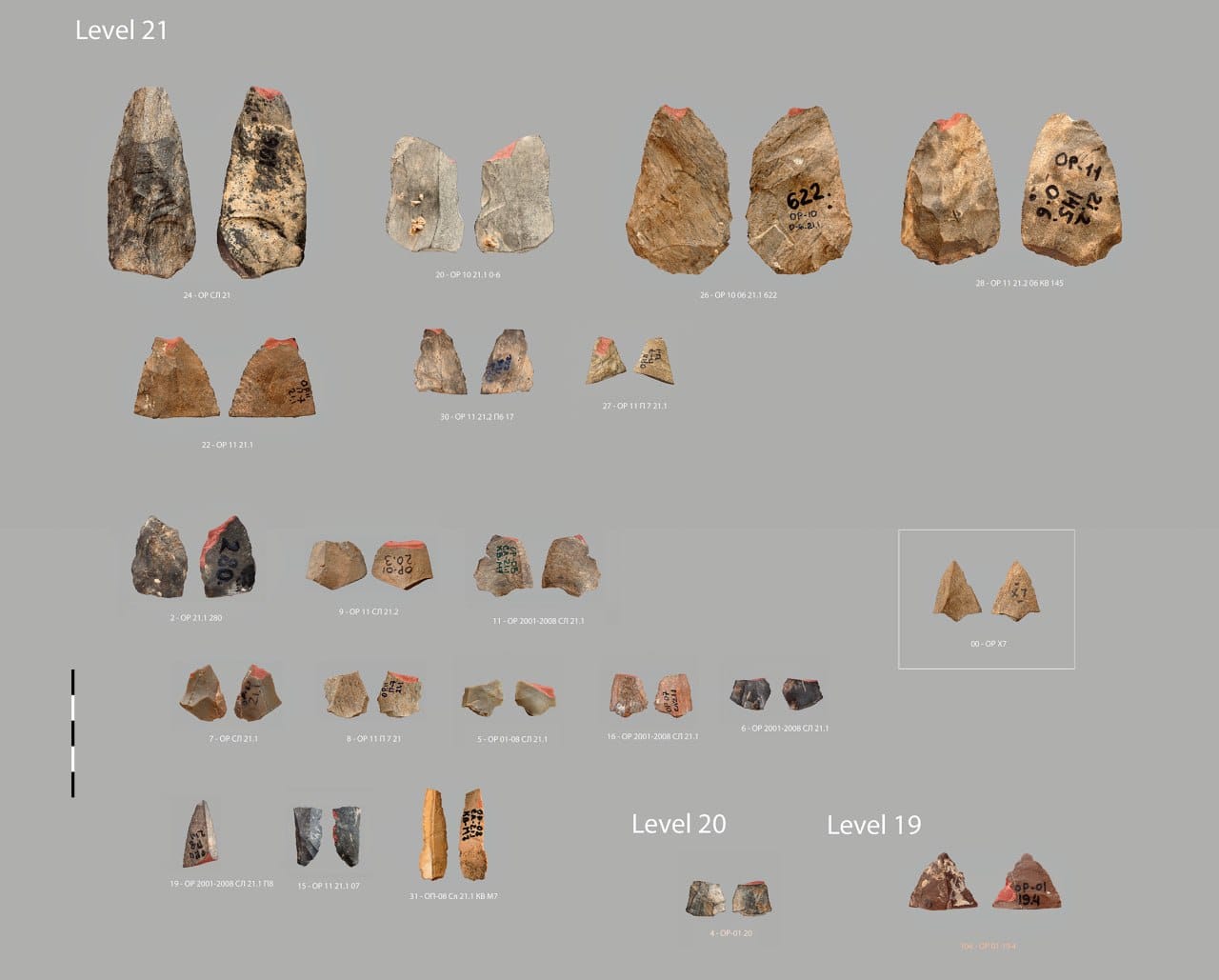
Tiny stone points 80,000 years old have been found in Uzbekistan's Obi-Rakhmat cave, which by wear traces and mass can only have served as arrowheads: that is, the earliest evidence of ranged weapons in Eurasia. Such technology has hitherto been associated exclusively with Homo sapiens, so the find means that our species was living in Central Asia with a bow in hand twenty-five thousand years before it appeared in Europe. The earliest known microlithic points come from South Africa, and are roughly as old as the finds from Obi-Rakhmat. The question arises whether this technology was carried out of Africa together with the dispersal of Homo sapiens or invented on the spot. The authors lean towards the second, because the two regions are separated by some 14,000 kilometres, and the points themselves are made differently in Africa and in Central Asia.
The excavations at the site are led by Andrey Krivoshapkin; the traces of use on the tools were studied by Hugues Plisson; the authors' team also includes Alyona Kharevich, Vladimir Kharevich, Pavel Chistyakov, Lidiya Zotkina, Malvina Baumann, Eric Pubert, Ksenia Kolobova and Farkhod Maksudov.
By microliths archaeologists mean miniature stone artefacts which early man set into a wooden or bone base to make a composite tool. The finds from Obi-Rakhmat are triangular in shape, bear no traces of retouch (that is, additional working of the edge by fine flaking), measure no more than two centimetres across and weigh only a few grams.
The authors applied use-wear analysis, that is, the study of microscopic traces of wear on the surface of a tool and the comparison of these traces with reference samples obtained in special experiments. In addition, the researchers calculated the ballistic characteristics that follow from the mass and shape of the pieces. In their conclusion, such inserts could have functioned only in a light projectile weapon for ranged combat, since the more massive points from the same assemblage are three or four times thicker, while the microliths themselves are fifteen to twenty times lighter than those points.
The researchers separately point to the similarity of the Obi-Rakhmat finds to the micro-points from the French site of Mandrin, where traces of the presence of Homo sapiens are dated to 54,000 years ago. The two sites are separated by more than six thousand kilometres and twenty-five thousand years, yet the authors write that the tools are so close that they could be swapped, and only the type of stone would betray the substitution.
The authors describe the context of this comparison as follows. Assemblages in which different types of projectile inserts are present at once, and in which some of the pieces were deliberately made in a microlithic form, are known to archaeologists only at Homo sapiens sites. Among Neanderthals such pieces are found extremely rarely and do not differ in size or type from tools of other purposes. The earliest documented examples of this technology come from South Africa, where the Pre-Still Bay assemblages and the material from Sibudu Cave are dated to more than 77,000 years ago. The distance between South Africa and Central Asia is about 14,000 kilometres, and the methods of shaping the points differ in the two regions, so the authors consider the hypothesis of independent centres of invention of this technology the most probable.
Fragments of a child's skull about 70,000 years old had previously been found at Obi-Rakhmat. The authors relate their conclusions to the data of palaeogenetics, according to which the ancestors of modern non-African populations lived for a long time in the depths of Eurasia, and stress that in this case material culture and genetics coincided, although the two lines of evidence developed independently of each other