Kazakhstan Is Restoring the Tiger Population Lost at the Beginning of the Twentieth Century
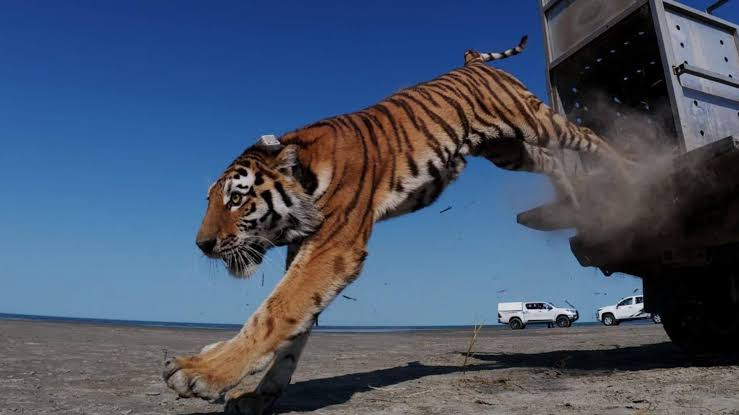
I have already told in detail how the last Turan tiger of the Great Steppe was killed by hunters in the last century. In 2025 I wrote that the actual release of tigers into the wild of Kazakhstan was still a long way off, and now it has come to pass. Our dear officials have not let us down! My heart fairly rejoices!
I am happy to report that in early August a female Amur tiger named Ümit (Үміт) was released in the Ile-Balkhash reserve. From the standpoint of modern science, the Amur and Turan tigers are one and the same subspecies. Because the regions they inhabit lie so far apart, they were long regarded as different subspecies, but a detailed genetic study of museum remains of the Turan tiger established that the ancestral population, moving out of the territory of China, split about ten thousand years ago. Some of the tigers advanced into Central Asia, others went to the Far East. What is more, it is now customary to unite in a single mainland subspecies other forms formerly distinguished as separate, the Bengal tiger, for instance, being counted among them.
It is precisely this close genetic kinship that inspires confidence in the success of the reintroduction.
Ümit is the first tiger to enter the wild of Kazakhstan in more than seventy years. The work that led to this began in 2017, when Kazakhstan and WWF signed a memorandum on returning the tiger to the delta of the Ili River and the Southern Balkhash region. A year later the reserve itself was created for the programme, with an area of more than 415 thousand hectares.
It was not the predators that were brought into the reserve first, but those standing lower in the food chain. In 2019 five Bukhara, or tugai, deer from the Syrdarya-Turkestan Regional Nature Park were released into the reserve. In 2020 fourteen adult animals and one fawn were added, and in July 2021 as many as sixty-one at once. The total density of ungulates at which a territory is considered ready to receive a tiger must reach twenty-five to thirty animals per thousand hectares. Besides the deer, the food base includes wild boar and roe deer, and in addition the kulan, saiga and goitered gazelle.
Tigers began to be brought to Kazakhstan in September 2024, when two arrived from the Netherlands, from the predator rehabilitation centre at the Landgoed Hoenderdaell zoo. In May 2026 four more Amur tigers were delivered from Russia, two adults and two young ones. Of these six, only Ümit has so far gone out into the wild. The adult male is undergoing behavioural tests, and no decision on his release has yet been taken. The two cubs are to remain in enclosures until they are eighteen months old.
It seems that in an age of empty bureaucratic promises, of constant deception on the part of those in power and of castles in the air built at the taxpayer's expense, so large and concrete a step towards restoring natural diversity is simply a miracle. Thanks to all concerned, to everyone involved in the process!
In parallel, a second site is operating in Kazakhstan, in the Turgay steppe. The reintroduction centre on the territory of the Altyn Dala reserve in the Kostanay region began to be built in 2012, and since 2017 the population of the kulan, a relict Asian wild mammal of the horse family, has been restored there. The first nine kulans were brought from the Altyn-Emel national park. The Kazakh subspecies of the kulan vanished in the 1930s, so the Turkmen one is used. The latest group was released in September 2025. The animals spent a year on fifty-six hectares, after which the gates were simply opened and they were allowed to depart in small groups.
The Przewalski's horse has been returned to the same place. In June 2025 eight animals were delivered on military aircraft, four from Prague Zoo and four from the Hungarian Hortobágy national park. In May 2026 five were set free. This is not the first time Prague Zoo has done this: by the same scheme, horses have already been returned to Mongolia