Herzen was finishing "My Past and Thoughts" in London, and visiting compatriots scolded him for having long since left Russia and forgotten it too well
Herzen was finishing "My Past and Thoughts" in London, and visiting compatriots scolded him for having long since left Russia and forgotten it too well. The émigré is always charged with forgetfulness, though it is usually the homeland that does the forgetting. This week, in the rubric of where to go, there are seven exhibitions about Russia seen from outside and carried back home, about displacement and the fragility of heritage: from Serbian frescoes saved by a Russian brush in 1912 to Sister Joanna, who painted icons in Paris, and a Vyatka émigré who settled in Italy, from a princely collection dispersed among museum holdings to the ideal autocrat and fading pastel.
🇷🇸"Serbian Medieval Monuments in Danger" at the Shchusev Museum of Architecture, Apothecary Office (Aptekarsky Prikaz) hall on Vozdvizhenka, 22 May - 19 July 2026. An international project, Serbian Medieval Monuments in Danger, marking twenty years since the Visoki Dečani Monastery was inscribed on the UNESCO World Heritage List: four Kosovo monuments that have been classed as endangered for almost two decades. The chief treasure is the painted copies of frescoes from Kalenić, Žiča and Manasija, made by the Russian artist Valentin Shcherbakov in 1912 and left in the MUAR holdings for over a century. Sometimes the copy proves more durable than the original, which is the most awkward commentary on the very idea of cultural heritage.
👑"Nicholas I. The Ideal Autocrat" at the State Historical Museum, 17 September 2025 - 22 June 2026, Hall 36. Marking the 200th anniversary of his accession to the throne: more than 260 objects, the monarch's personal belongings, materials from the State Archive and the Kremlin Museums. The era that opened with the Decembrist uprising and closed with the Crimean catastrophe is presented as Nicholas himself would have wished, as ideal autocracy without upheaval, while in its lectures the Museum calls him "the Don Quixote of autocracy". It closes on 22 June, so the ideal autocrat remains at your disposal for another three weeks.
🏛"Collections of Russia. The Baryatinskys" at the Pushkin State Museum of Fine Arts, April - July 2026. From the Pushkin Museum's series on Russian private collections: this time the Princes Baryatinsky, whose family collecting and country-house way of life took shape over generations until history scattered it all among museum holdings. The subject is how an aristocrat's private passion for things ends up as state property with an inventory number. Noble dignity, laid out in display cases.
🇮🇹"Alexey Isupov: Between the Vyatka and the Tiber. The Russian Soul in the Rays of the Italian Sun" at the Solzhenitsyn House of Russia Abroad, 28 April - 13 September 2026. The son of a Vyatka iconostasis master, a graduate of the Moscow School of Painting, Sculpture and Architecture, an Impressionist, he settled in Italy in emigration and signed himself Alessio Issupoff. In Rome came commercial success, at home oblivion: the core of the exhibition has come from the Vyatka Museum, to which his widow handed over more than three hundred works only in the late 1970s. To leave as a Russian and return as an Italian is a story that this season invites a closer look.
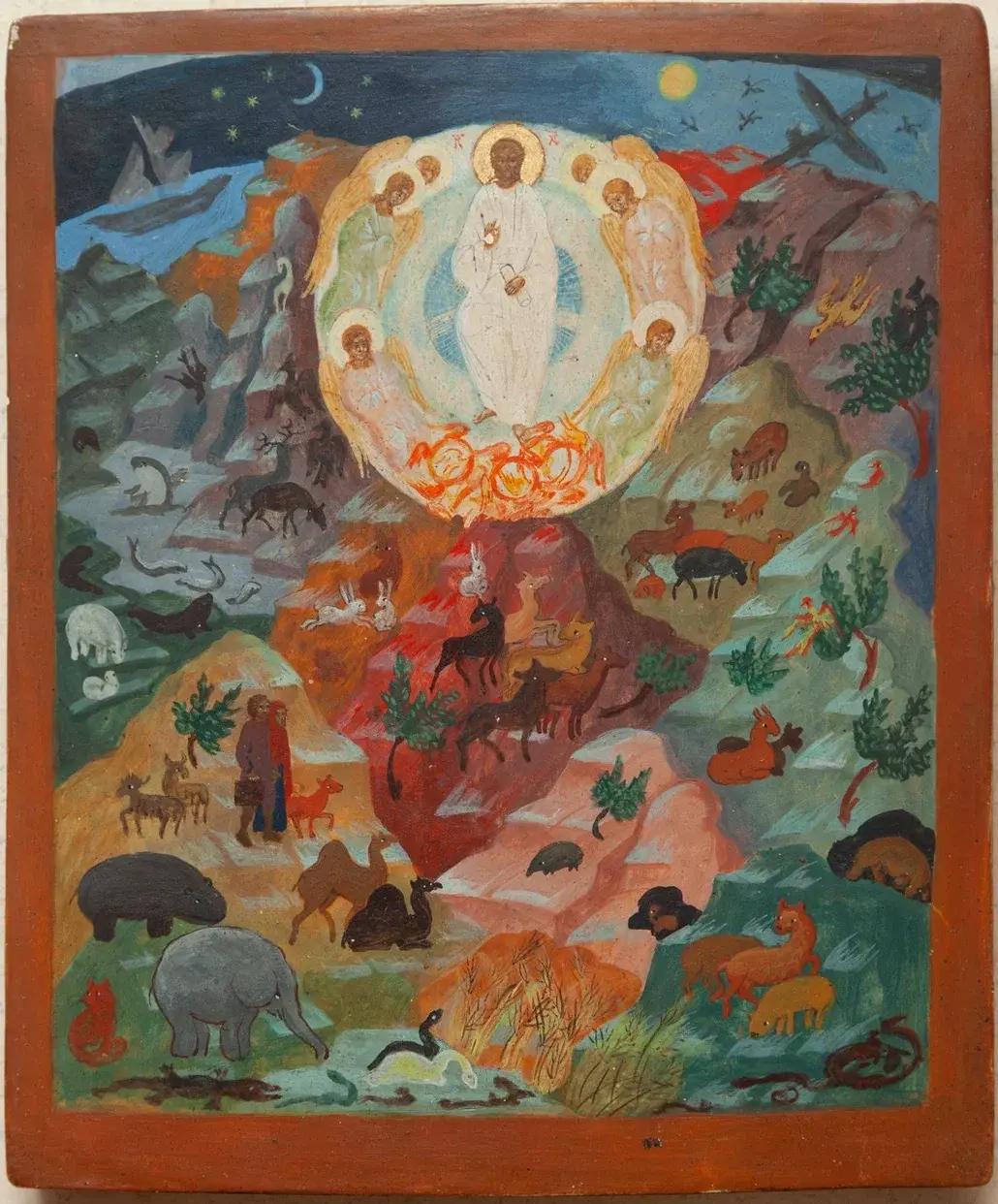
⛪️"Under the Blue Sky…" at the same House of Russia Abroad, until 26 July 2026. Yulia Reitlinger, in monastic life Sister Joanna (1898-1988), an icon painter and spiritual daughter of Father Sergei Bulgakov, whom she followed to Paris in 1925 and stayed with until his death. Saint Petersburg, Prague, Paris, Tashkent: icons, drawings and book illustrations in which canon is fused with the avant-garde, assembled from the House of Russia Abroad, the Andrei Rublev Museum and seventeen private collections. Two émigré destinies under one roof, so go in for both at once.
🏔"Semyon Chuikov. Legacy of an Epoch" at the Tretyakov Gallery on Kadashevskaya Embankment, 7 April - 12 July 2026. Chuikov (1902-1980) gave Soviet painting Central Asia: Kyrgyz steppes, eastern light, the "Daughter of Soviet Kyrgyzstan" from every textbook. The retrospective shows a master who could paint the periphery so that it looked like the centre of the world.
🖼"Fragile Art. Pastels from the Graphic Art Holdings, 18th - Early 20th Century" at the Tretyakov Gallery, 27 March - 1 November 2026. Pastel fears light and scarcely ever leaves the storerooms, so such displays are rare by definition: paper, dry pigment, an instantaneous gesture held together by a prayer and fixative. To see what normally lies in the dark under conservation conditions is worth more than many a loudly trumpeted retrospective.