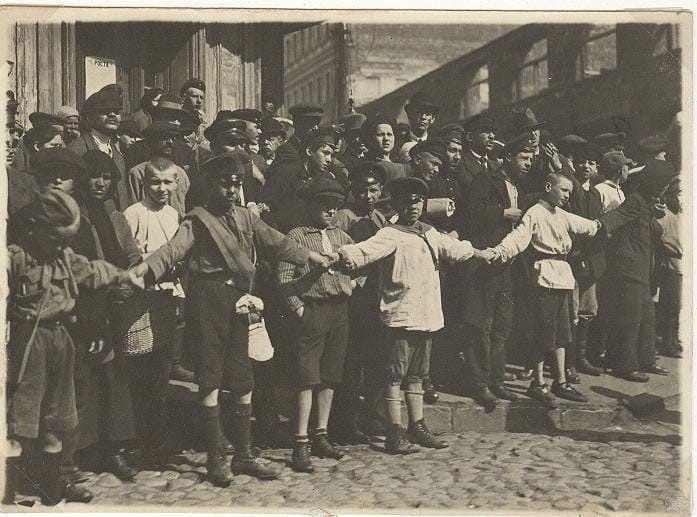
Boy Scouts Cordoning Off the Burning Savvinskoye Compound in 1918
The fire was not in the building of the Savvinskoye Compound itself, but in the studio of Alexandr Khanzhonkov, the man who filmed "The Defence of Sevastopol" and "The Beautiful Lukanida". The studio stood in the courtyard of the compound as a separate pavilion. It was there that Khanzhonkov had set up, from 1908, a demonstration hall, a shop selling apparatus, distribution offices and the filming pavilion proper, built in the courtyard with the permission of the bishop who administered the compound. Rare equipment, invaluable reels of film, sets and props were burnt. Part of Khanzhonkov's archive was thus lost irretrievably, which is, among other things, the reason why many of the studio's films have not come down to us.
But what astonishes is precisely the children posted in the cordon around the building. Adolescents in the uniform of the movement founded in tsarist Russia in 1909 by Staff Captain Pantyukhov. Before long they would be disbanded as a "bourgeois phenomenon" and replaced by the Pioneers. For the moment, however, they hold the perimeter around burning private property which the new authorities had not yet managed to nationalise.
After February the Scouts still took part in public life: they kept watch in the streets, distributed provisions, helped the wounded and guarded various sites at a time when the police had vanished and the militia had not yet taken shape. Moscow Scouts were regularly called upon by the city authorities for auxiliary guard duties, such as cordoning off areas, helping the firemen by supplying water, carrying messages and protecting property from looters. Boy Scouts all over the world did something similar in the First World War. In England they stood duty at railway stations, delivered post and watched over the coast; in France they collected metal and helped the hospitals.