The Bolshoi Drama Theatre repeats “The Trial of Raskolnikov” for the Dostoevsky centenary in Petrograd
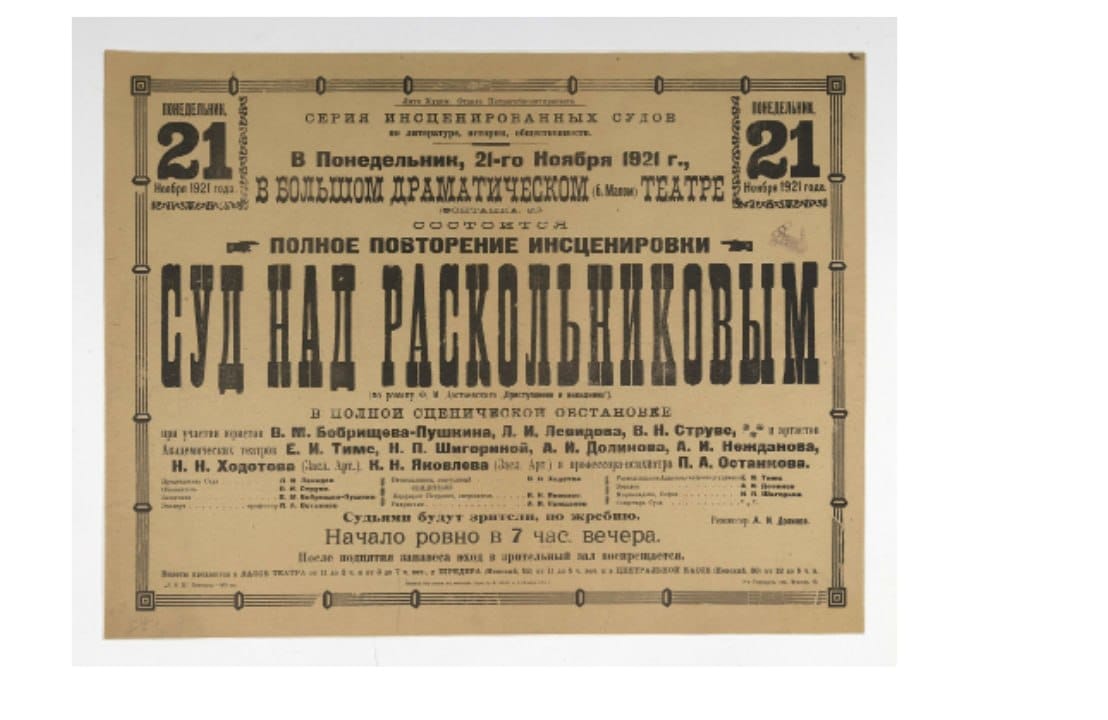
The playbill of the Bolshoi Drama Theatre announces a full repeat of the staged "Trial of Raskolnikov" on 21 November 1921
On 11 November 1921 (30 October, Old Style) it was one hundred years since the birth of Dostoevsky, and Petrograd marked the writer's jubilee. A trial of his most famous hero made it possible to speak of Dostoevsky without passing sentence on the author himself.
In the early 1920s the so-called agitation trials were staged all over the country: mock proceedings in which the public sat as jurors and decided the defendant's fate for themselves. Their organisers held that such a trial worked better than a lecture or a play, because it drew the spectator into the action. They tried drunkards, absentees, priests, saboteurs and, for good measure, literary characters. Raskolnikov, with his axe, his theory of the "trembling creatures" and the right of the strong to shed blood, was ideally suited to such a process: in 1921 the question whether it is permitted to kill for the common good sounded anything but literary.
The Bolshoi Drama Theatre opened in February 1919 on the initiative of Maxim Gorky and Maria Andreyeva, and its directorate was chaired by Alexander Blok. The theatre was conceived as a stage of lofty tragedy and heroic drama for the new spectator. From 1920 it worked in the former Suvorin Theatre on the Fontanka. In August 1921 Blok died, and the theatre met that autumn without its first head